
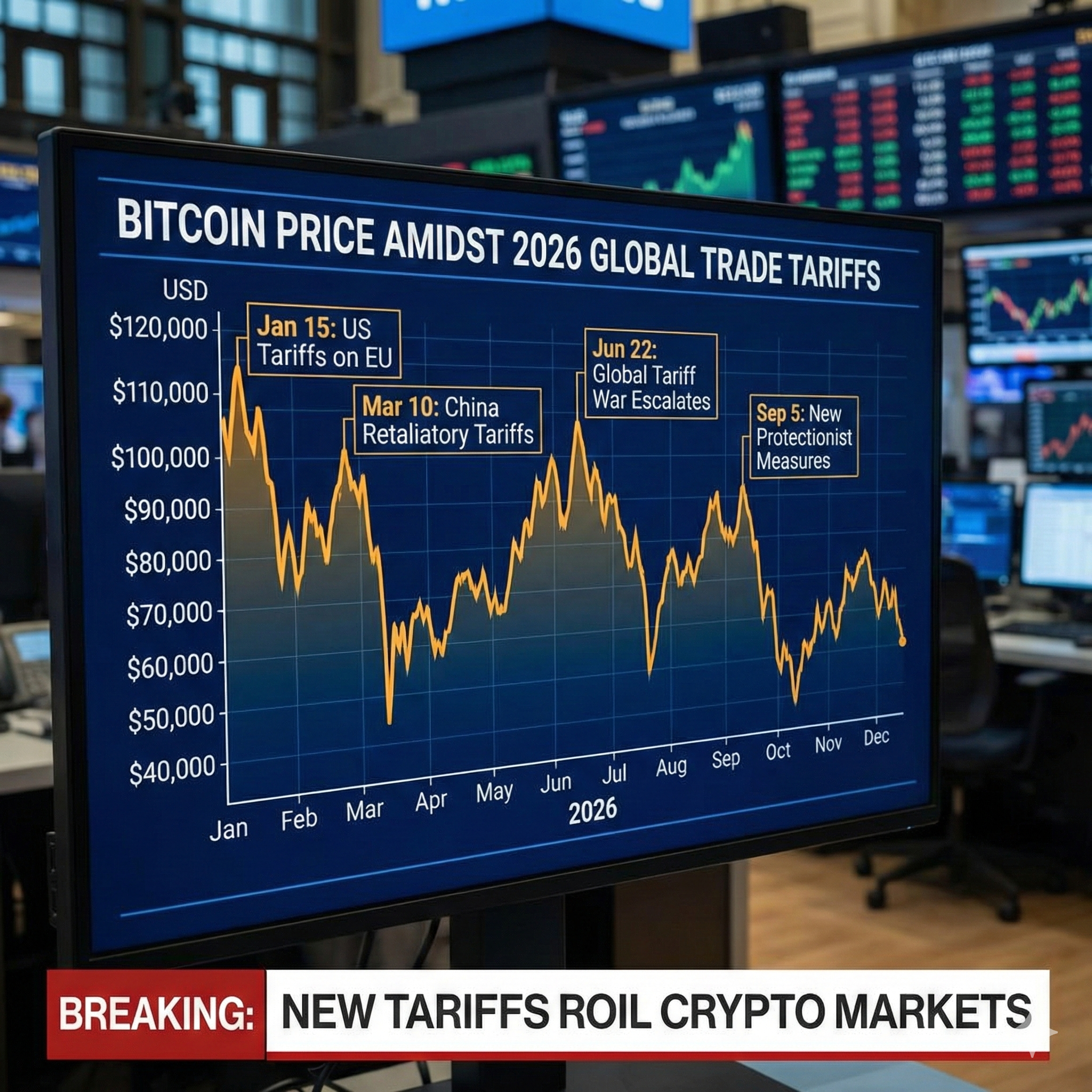
Executive Summary: The Confluence of Protectionism and Digital Asset Volatility
The first quarter of 2026 has inaugurated a period of profound transformation and heightened instability within the global financial architecture. Investors, having navigated the speculative fervor of late 2025 which saw Bitcoin (BTC) crest at an all-time high of approximately $126,000, are now grappling with a starkly different reality.1 By early February 2026, the digital asset ecosystem has undergone a severe correction, with Bitcoin trading below the psychological $80,000 threshold, representing a drawdown of nearly 39% from its peak.2 This report posits that the current market environment is not merely a cyclical technical correction but a structural repricing of risk assets driven by a "Perfect Storm" of macroeconomic variables: the aggressive resumption of protectionist trade policies under the second Trump administration, a contentious transition in Federal Reserve leadership, and a legislative impasse regarding U.S. cryptocurrency regulation.
The central thesis of this outlook is that Bitcoin volatility has transitioned from being a function of retail speculation to a barometer of global liquidity stress and geopolitical fracture. The sharp spike in the Bitcoin Volatility Index (DVOL) to levels exceeding 44 in late January 2026 serves as a quantitative indicator of this shift.4 As the United States initiates broad tariffs—ranging from 25% on North American partners to targeted escalations against China and diplomatic leverage plays involving Greenland—the correlation between Bitcoin and traditional risk assets like the Nasdaq has tightened significantly, reaching 0.74.5 This high correlation challenges the asset's "digital gold" narrative in the short term, exposing it to the stagflationary headwinds of reduced growth and sticky inflation.
However, beneath the surface of this Bitcoin volatility, structural adoption trends remain resilient. The emergence of "Digital Asset Treasury 2.0" models, the deepening of sovereign wealth interest, and the continued integration of blockchain technology by major financial institutions suggest that the current downturn may represent a significant accumulation opportunity for long-time horizon investors. This report provides an exhaustive analysis of these dynamics, offering a sector-by-sector breakdown of the Q1 2026 landscape and projecting scenarios for the remainder of the fiscal year.
1. The Macro-Economic Supercycle: Tariffs, Trade Wars, and the New Protectionism
The dominant economic narrative of early 2026 is the rapid and aggressive implementation of a "Trump 2.0" trade agenda. Unlike the trade wars of 2018-2019, which were largely bilateral and focused on China, the 2026 tariff regime is omnidirectional, impacting allies and adversaries alike. This shift has introduced a profound uncertainty into global supply chains, directly feeding into Bitcoin volatility by altering the liquidity conditions of the U.S. dollar and the profitability of the tech sector.
1.1 The North American Tariff Shock
In a move that surprised many observers with its speed, the administration rolled out a 25% tariff on goods from Mexico and Canada in January 2026.6 This policy, aimed at renegotiating the terms of the USMCA and addressing immigration concerns, has had immediate ripple effects through the U.S. economy.
- Supply Chain Disruption: The integrated automotive and energy supply chains of North America were thrown into disarray. Major U.S. manufacturers, heavily reliant on cross-border parts, faced immediate input cost spikes. This supply shock is inflationary, contributing to the "sticky" CPI prints seen in January.7
- Market Reaction: The S&P 500 and Nasdaq responded negatively, fearing margin compression. Bitcoin, acting as a high-beta liquidity proxy, suffered alongside these equities. The correlation logic holds that if U.S. corporations (the primary engines of stock market value) face higher costs, their earnings multiples must contract. Since Bitcoin is often traded by macro funds as a risk-on asset alongside tech stocks, it was sold off in the liquidity drain.8
- Specific Escalations: The tension extended to the aerospace sector, with threats of a 50% tariff on Canadian aircraft if certification disputes regarding Gulfstream jets were not resolved.9 Such granularity in tariff threats creates a volatile environment where specific sectors can crash overnight, dragging broader indices and crypto sentiment down with them.
1.2 The China Semiconductor War and AI Implications
Beyond North America, the administration intensified its economic containment strategy against China. A new 10% tax on Chinese products was layered on top of existing duties.6 More critically, the Department of Commerce implemented strict export controls and tariffs on advanced AI commodities and semiconductors.10
- The AI Connection: The intersection of AI and Crypto is a major theme for 2026. Restrictions on Nvidia H200 and AMD MI325X chips to China directly impact the global compute market.10 Bitcoin miners, who compete for similar semiconductor foundry capacity, face potential supply chain squeezes and price hikes for ASIC hardware.
- Bitcoin Volatility Impact: The crypto market, particularly the AI-coin sector (e.g., Render, Fetch.ai), reacted violently to these restrictions. Bitcoin itself saw increased volatility as traders speculated on the broader economic fallout of a U.S.-China decoupling. The fear is that China might retaliate by dumping U.S. Treasuries, spiking yields and crushing risk asset valuations—a scenario that historically sends Bitcoin volatility soaring.8
1.3 The Greenland Diplomatic Crisis and European Tensions
Perhaps the most idiosyncratic and destabilizing event of Q1 2026 was the "Greenland Tariff" dispute. The administration threatened tariffs on eight European nations as leverage in negotiations to purchase or secure defense rights over Greenland.12
- Geopolitical Risk Premium: Although the administration signaled a willingness to back down after intense European pushback, the incident underscored the transactional and unpredictable nature of U.S. foreign policy in 2026.14 This unpredictability drives capital into safe havens. Interestingly, in this specific instance, capital flowed into the U.S. Dollar (DXY) and Gold, rather than Bitcoin.
- The Euro Weakness: The threat of tariffs on EU economies caused the Euro to weaken, boosting the DXY. A strong DXY is mathematically bearish for Bitcoin (denominated in USD). The strength of the dollar during the Greenland crisis was a key contributor to Bitcoin losing the $90,000 support level in late January.15
1.4 The "Stagflation" Threat
The aggregate impact of these tariffs is estimated to have shaved approximately 2% off U.S. economic growth forecasts for 2026 while keeping inflation elevated.11 This creates a "stagflationary" environment—low growth, high prices.
- Bitcoin's Behavior: In true stagflation, cash loses value (inflation), but stocks perform poorly (low growth). Theoretically, this is the ideal environment for hard assets like Gold and Bitcoin. However, Bitcoin volatility in the short term reflects the market's fear of the "growth" component slowing down. It is currently trading more like a tech stock fearful of recession than a commodity hedging inflation.8
- Long-Term Thesis: Analysts at Grayscale and other firms argue that this is a temporary misalignment. As the tariffs structurally weaken the dollar's global dominance over the medium term, creating space for "anti-dollar" competitors, Bitcoin is expected to decouple and rally. The "anti-dollar trade" narrative is gaining traction among macro strategists who view the 2026 tariff regime as the catalyst for a multipolar monetary system.11
2. Federal Reserve Policy: The Pivot That Wasn't
Monetary policy remains the gravitational force of the crypto market. The expectation coming into 2026 was a continued cycle of rate cuts. The reality has been a "hawkish pause," complicated by a high-stakes leadership transition.
2.1 The January 2026 FOMC Decision
At the January 28, 2026 meeting, the Federal Open Market Committee (FOMC) voted to hold the federal funds rate steady at 3.5%–3.75%.17
- The Pause: This decision halted the trend of rate cuts that began in late 2025. The rationale was clear: with CPI inflation at 2.7% (above the 2% target) and tariffs introducing new price pressures, the Fed could not justify further easing.7
- Dissension: The vote was not unanimous, with two members dissenting in favor of a cut.18 This internal conflict highlights the difficulty of the current environment. The majority view, however, emphasized that the economy remains resilient ("no landing") and that premature cuts could reignite inflation.
- Impact on Bitcoin Volatility: Markets hate uncertainty. The pause, combined with "low odds" of a March cut, removed the liquidity injection traders were betting on. Bitcoin volatility spiked as leverage was flushed out of the system; traders who had levered up expecting "cheap money" were forced to liquidate positions as the cost of capital remained high.20
2.2 The Kevin Warsh Nomination
The most significant monetary development of Q1 2026 is President Trump's nomination of Kevin Warsh to replace Jerome Powell, whose term ends in May 2026.21
- The Profile: Kevin Warsh is a former Fed Governor (2006-2011) known for his hawkish stance and criticism of the Fed's "asset price support" policies. He has argued that the Fed has engaged in "mission creep" and should focus strictly on price stability, even if it means higher volatility in equity markets.23
- The "Productivity" Pivot: While historically a hawk, recent analysis suggests Warsh may align with the Trump administration's "productivity" thesis. This view argues that if deregulation and AI investment (supported by the administration) increase economic productivity, the economy can sustain lower interest rates without causing inflation. If Warsh adopts this view, he might cut rates aggressively in H2 2026 to support the administration's growth targets.25
- Bitcoin Reaction: The immediate market reaction to Warsh's nomination was mixed. The dollar strengthened (bearish for BTC) as traders anticipated a more disciplined Fed. However, Warsh's support for the U.S. digital dollar and stablecoin regulation (GENIUS Act) suggests he sees a place for crypto technology, albeit within a strictly regulated framework.26
- Independence Questions: There is significant debate regarding how independent Warsh will be from the White House. While some fear political pressure to cut rates (bullish for risk assets), Warsh's history suggests he values institutional credibility. This tension between political pressure and institutional history is a key driver of Bitcoin volatility, as the market attempts to price in the "Warsh Put" vs. the "Powell Put".22
2.3 Rate Outlook for the Remainder of 2026
The consensus among major banks (J.P. Morgan, Goldman Sachs) has shifted.
- Q1-Q2: The Fed is expected to remain on hold through the first half of the year. The March meeting is viewed as a non-event for cuts.18
- H2 2026: Strategists expect one or two rate cuts starting in June or July, bringing the rate down slightly to around 3.25%.29
- Implication: This "higher for longer" reality means that Bitcoin volatility will likely remain elevated in the first half of the year as the asset struggles against the gravity of 3.5% risk-free yields. The true bull market catalyst—liquidity expansion—is delayed until summer.
3. Bitcoin Volatility Dynamics: Anatomy of the Q1 Crash
To understand the future, we must dissect the recent past. The price action of January 2026 provides a textbook case study in how Bitcoin volatility manifests in a mature but fragile market structure.
3.1 The January 31st Flash Crash
On January 31, 2026, Bitcoin suffered one of its steepest single-day declines in years, plunging from over $84,000 to a low of $75,644.2
- Trigger Event: The crash was precipitated by a sharp sell-off in the tech sector. Microsoft (MSFT) dropped 12% on January 30 due to concerns over AI capital expenditure returns.31 This triggered a risk-off wave across the Nasdaq.
- Correlation Spike: Bitcoin's correlation with the Nasdaq hit 0.74, meaning for every 1% the Nasdaq dropped, Bitcoin dropped roughly 0.74% (amplified by leverage). This disproves, for the moment, the theory that Bitcoin is an uncorrelated asset.5
- Liquidation Cascade: The move triggered a massive liquidation event. Over $2.5 billion in futures positions were wiped out in 24 hours, with $2.41 billion being long positions (bets on price going up).3 This "long squeeze" exacerbated the downward move, as liquidated longs are forced to sell, driving prices lower in a feedback loop.
3.2 Volatility Metrics
- DVOL (Deribit Volatility Index): The DVOL index spiked from 37 to 44.4 While this is a significant jump, historical analysis shows DVOL often hits 70+ during true capitulation bottoms (like Nov 2022). A reading of 44 suggests "high anxiety" but not yet "total panic," implying that Bitcoin volatility could have room to run higher before the market finds a definitive floor.
- Fear & Greed Index: The sentiment index plummeted to 20 ("Extreme Fear"), a stark contrast to the "Extreme Greed" (80+) seen during the October 2025 all-time highs.32 Contrarian investors often view readings below 20 as buy signals.
- Prediction Markets: Polymarket contracts regarding "Bitcoin Volatility 2026" show a 35% probability of DVOL doubling again this year. This indicates that sophisticated traders are hedging against further geopolitical or regulatory shocks.33
3.3 Liquidity Drought
A key driver of this Bitcoin volatility is the thinning of liquidity order books.
- Coinbase Premium: The Coinbase Premium (the difference between BTC price on Coinbase vs. Binance) turned negative, signaling that U.S. institutions were net sellers.34
- Realized Cap: On-chain data shows that "Realized Cap" (the aggregate cost basis of all coins) has flatlined. This means new capital is not entering the space to absorb the selling pressure from miners and long-term holders taking profit.34 Without new inflows, volatility increases because it takes less volume to move the price significantly.
4. The Regulatory Landscape: Legislative Gridlock and Opportunity
Regulation was supposed to be the tailwind for 2026. Instead, it has become a headwind. The failure of the flagship "Clarity Act" has left the industry in a state of uncertainty, contributing to the capital flight and Bitcoin volatility observed in Q1.
4.1 The Failure of the Clarity Act
The "Digital Asset Market Clarity Act" was designed to settle the jurisdiction war between the CFTC and SEC.
- The Collapse: Despite advancing out of the Agriculture Committee, the bill stalled in the Banking Committee due to lack of bipartisan support.35 The impasse centered on consumer protection provisions and the definitions of "ancillary assets."
- Industry Revolt: Coinbase CEO Brian Armstrong publicly withdrew support for the bill in January 2026, citing amendments that would have banned yield on stablecoins and empowered the SEC.35 Armstrong's pivot was a signal to the market that the bill had become "poisoned," leading to a sell-off in assets that would have benefited from regulatory clarity (like DeFi tokens).
- Market Impact: The legislative limbo means institutions remain hesitant to deploy capital at scale. This lack of a "regulatory moat" keeps volatility high, as every enforcement action or rumor moves the market.
4.2 The GENIUS Act and Stablecoins
While the broader market structure bill failed, the "Guiding and Establishing National Innovation for U.S. Stablecoins Act" (GENIUS Act) is gaining momentum.37
- Warsh's Support: Incoming Fed Chair Kevin Warsh is a proponent of this bill. It focuses narrowly on regulating stablecoins (USDC, PYUSD) as payment instruments.
- Implications: If passed in mid-2026 (projected July 2026), this would be bullish for the crypto ecosystem's utility but neutral/bearish for Bitcoin volatility. Regulated stablecoins lower the friction for entering/exiting positions, potentially smoothing out volatility over the long term. However, in the short term, the focus on stablecoins (essentially digital dollars) reinforces the dollar's dominance rather than Bitcoin's.38
4.3 Global Regulatory Arbitrage
While the U.S. stumbles, the rest of the world is moving forward.
- MiCA in Europe: The EU's Markets in Crypto-Assets (MiCA) regulation is fully operational, providing a clear rulebook for issuance and trading.
- Asia: Hong Kong and Japan have updated their frameworks for Virtual Asset Service Providers (VASPs) and stablecoins.38
- The Flight: Capital is flowing to these jurisdictions. This "regulatory arbitrage" explains why Bitcoin prices often hold up better during Asian trading hours than U.S. hours (as evidenced by the negative Coinbase Premium). The U.S. regulatory uncertainty is a specific driver of U.S.-centric Bitcoin volatility.
5. Institutional and Corporate Adoption Trends
Despite the gloomy price action, the underlying trend of institutional adoption continues to evolve. The "Digital Asset Treasury" (DAT) model is maturing, and sovereign interest is growing.
5.1 ETF Flows: The Cool-Down
After a record-breaking 2025, U.S. Spot Bitcoin ETFs saw net outflows of ~$2.7 billion in January 2026.21
- Reasoning: This is a classic "risk-off" rotation. With 10-year Treasury yields rising and the Fed pausing cuts, asset allocators are rebalancing out of volatile assets into guaranteed yield.
- Long-Term View: Major players like BlackRock and Fidelity remain committed. BlackRock increased its holdings in Strategy (formerly MicroStrategy) significantly, showing they are playing the proxy game as well as the direct ETF game.5
5.2 MicroStrategy and DAT 2.0
The strategy of holding Bitcoin on corporate balance sheets is facing its first major stress test in a high-rate, high-tariff environment.
- MicroStrategy (MSTR): The stock dropped over 50% from its highs, acting as a leveraged play on Bitcoin's downside.39 However, the firm continues to acquire Bitcoin, adhering to its long-term thesis.
- DAT 2.0: A new wave of companies is exploring "DAT 2.0"—not just holding BTC, but using it. This involves using Bitcoin for cross-border settlement to avoid tariff-related currency fluctuations and engaging in "block space procurement" for decentralized data storage.40 While still nascent, this shifts the narrative from "speculation" to "utility."
5.3 Sovereign Adoption Rumors
The "Game Theory" of nation-state adoption is alive in 2026.
- Strategic Reserves: Following discussions in the U.S. about a strategic Bitcoin reserve, other nations are rumored to be accumulating. Reports suggest that sovereign wealth funds in the Middle East and smaller nations are exploring Bitcoin as a "neutral reserve" asset to hedge against the weaponization of the US dollar via tariffs.41
- Central Banks: The Czech National Bank (CNB) governor hinted at using tokenized assets, and Deutsche Bank predicts widespread central bank adoption by 2030.37 While not an immediate buyer of billions in Q1, the mere possibility puts a floor under long-term price expectations.
6. Technical and On-Chain Analysis: Finding the Floor
Technical analysis in the midst of Bitcoin volatility requires a focus on key support levels and on-chain behaviors that signal capitulation.
6.1 Price Levels to Watch
- The Ceiling ($90k - $92k): This zone, previously support, is now formidable resistance. It coincides with the 50-day Exponential Moving Average (EMA). A reclaim of this level is required to flip the trend bullish.2
- The Pivot ($80k): The psychological line in the sand. Trading below this level signals weakness.
- The Floor ($74k - $75k): The lows of early 2026. If this breaks, technical analysts point to the 2021 cycle high of $69,000 as the ultimate "line of defense." A break below $69k would be catastrophic for sentiment, potentially opening a path to the $55k-$60k "value zone".1
6.2 Cycle Analysis: Is the Bull Market Over?
There is a fierce debate regarding the 4-year cycle.
- The "Left-Translated" Cycle: Analysts like Benjamin Cowen argue that the cycle peaked early (October 2025) and that 2026 is a bear market year, similar to 2018 or 2022. They cite the Fed's reluctance to cut rates as the confirmational signal.44
- The "Supercycle" Theory: Others, like Standard Chartered ($150k target) and Grayscale, argue that the ETFs have changed the structure. They view this as a mid-cycle correction (similar to summer 2021) driven by policy shocks (tariffs), to be followed by a rally to new highs once the Fed pivots in H2 2026.43
6.3 On-Chain Metrics
- MVRV Ratio: The Market Value to Realized Value ratio has cooled significantly, moving out of the "overheated" zone. It is not yet in the "deep value" zone (usually < 1.0), suggesting price could go lower or consolidate for months.
- Hash Ribbons: With prices falling and energy costs rising (tariffs), miners are squeezing margins. If the Hash Ribbon indicator flashes a "Capitulation" signal, it historically marks a macro bottom. Currently, we are seeing early signs of miner stress but not yet full capitulation.5
7. Future Outlook: Scenarios for Q2-Q4 2026
Based on the confluence of tariffs, Fed policy, and market structure, three scenarios emerge for the remainder of 2026.
7.1 Scenario A: The "Hard Landing" Bear (Probability: 30%)
- Catalyst: The "Trump Tariffs" trigger a full-blown global trade war. China retaliates by devaluing the Yuan and dumping Treasuries. Inflation spikes to 4%, forcing Kevin Warsh to raise rates or hold them at 3.75% indefinitely.
- Bitcoin Volatility Impact: Volatility explodes (DVOL > 80). Bitcoin correlates 1:1 with a crashing Nasdaq.
- Price Target: $50,000 - $60,000.
- Indicator: 10-Year Treasury Yield > 5.0%.
7.2 Scenario B: The "Muddle Through" Consolidation (Probability: 50%)
- Catalyst: Tariffs are used as a negotiating tactic and are scaled back (transactional diplomacy). The economy slows but avoids deep recession. The Fed cuts rates once or twice in H2 2026. The GENIUS Act passes.
- Bitcoin Volatility Impact: Volatility remains elevated but range-bound. The market "chops" between extreme fear and neutral sentiment.
- Price Target: $75,000 - $110,000 (Range-bound).
- Indicator: DXY stabilizes around 102-104.
7.3 Scenario C: The "Sovereign Bull" Breakout (Probability: 20%)
- Catalyst: The U.S. Dollar weakens structurally due to debt concerns ($36T+ debt). A major G7 or BRICS nation announces a Bitcoin reserve. The Fed pivots aggressively to Save the Treasury market (Yield Curve Control).
- Bitcoin Volatility Impact: A "melt-up" volatility. Bitcoin decouples from equities and rallies with Gold.
- Price Target: $150,000 - $225,000.43
- Indicator: DXY breaks below 95; Gold hits $3,000+.
8. Conclusion: Navigating the Storm
The "Wild Ride" of 2026 is a narrative of an asset class maturing in real-time against a backdrop of geopolitical fragmentation. Bitcoin volatility in Q1 2026 is not a bug; it is a feature of a global liquidity gauge reacting to the withdrawal of cheap money and the erection of trade barriers.
For the immediate future (Q1-Q2), the path of least resistance appears to be sideways-to-down. The headwinds of the "Trump Tariffs," the "Warsh Fed," and the "Clarity Act Failure" are too strong to ignore. Investors should anticipate continued volatility, with the $75,000 support level serving as a critical battlefield.
However, the long-term thesis for Bitcoin remains intact and arguably strengthened by these very crises. The fiscal irresponsibility implied by permanent deficits and trade wars ultimately degrades the fiat currency. As the world fragments into tariff blocs, the utility of a neutral, borderless, digital bearer asset becomes theoretically undeniable. The question for 2026 is not if Bitcoin will recover, but when the macro-liquidity cycle will turn to support it. Until then, caution, hedging, and a close eye on the Federal Reserve's actions are the prudent strategies for navigating this turbulent market.
Data Tables & Reference Material
Table 1: 2026 Bitcoin Price Predictions by Major Institution
| Institution / Expert | Prediction (2026) | Rationale | Sentiment | Source |
| Standard Chartered | $150,000 | Institutional adoption, supply constraints | Bullish | 43 |
| J.P. Morgan | $120,000 | Decreasing volatility, gold parity | Neutral | 43 |
| CoinShares | $120k - $170k | Clarity on Fed policy in H2 2026 | Bullish | 43 |
| Carol Alexander | $75k - $150k | High volatility, retail wash-out | Volatile | 43 |
| VanEck | $180,000 | Sovereign adoption, monetary debasement | Bullish | 43 |
| Grayscale | New Highs | "Anti-dollar" trade, end of 4-year cycle | Bullish | 45 |
Table 2: Key Macro Events Calendar Q1-Q2 2026
| Date | Event | Expected Impact on Crypto Market | Source |
| Feb 11, 2026 | Jan CPI Data Release | High Volatility. If >3%, expect sell-off due to inflation fears. | 7 |
| March 17-18, 2026 | FOMC Meeting | Rate Decision. Market expects a pause. Any surprise cut is bullish. | 17 |
| April 2026 | Q1 Earnings | Correlation Check. Tech earnings will drive BTC price action. | 46 |
| April 27-29, 2026 | Bitcoin 2026 Conf. | Narrative. Major announcements often occur here (e.g. nation state adoption). | 47 |
| May 2026 | Fed Chair Transition | Policy Shift. Powell exits, Warsh enters. Critical for rate outlook. | 20 |
| June 2026 | Potential Rate Cut | Pivot. First potential pivot point for Bull run resumption. | 29 |
Table 3: The Tariff Impact Matrix
| Policy Action | Sector Impacted | Transmission to Bitcoin | Source |
| 25% Mexico/Canada Tariff | Auto, Energy | Inflationary -> Fed holds rates -> BTC Drops | 6 |
| 10% China Tariff | Consumer Goods | Supply Chain chaos -> Risk-off sentiment -> BTC Drops | 6 |
| Chip/AI Export Controls | Semiconductors | Mining hardware costs up -> Hash rate volatility -> BTC Volatility | 10 |
| Greenland Threats | Eurozone | Euro drops -> DXY rises -> BTC Drops (Inverse Correlation) | 12 |
Detailed Analysis of Upcoming Crypto Conferences as Catalysts
While macro factors dominate, industry events in 2026 may serve as local catalysts for price recovery or volatility spikes.
- ETHDenver (Feb 17-21, 2026): Historically a "builder" event. Expect announcements regarding Layer 2 scaling and potentially new "DeFi on Bitcoin" primitives that could boost on-chain activity.47
- Paris Blockchain Week (April 15-16, 2026): With Europe's MiCA regulation in place, this event will likely highlight institutional adoption in the EU, contrasting with U.S. stagnation.48
- Bitcoin 2026 (Las Vegas, April 27-29, 2026): The largest Bitcoin-specific event. Rumors persist that a major announcement regarding "Sovereign Adoption" or a "Strategic Reserve" could be timed for this event to reverse bearish sentiment.49
- Consensus 2026 (Miami, May 5-7, 2026): Occurring right before the Fed Chair transition, this will be the venue for the industry to align on lobbying efforts for the GENIUS Act and future stablecoin legislation.51
These events provide the "narrative" fodder that can drive short-term price action, even against a difficult macro backdrop. Traders should watch for "buy the rumor, sell the news" dynamics around these dates.
Disclaimer: This report is for informational purposes only and does not constitute financial advice. The cryptocurrency market is highly volatile and subject to rapid changes in regulation, technology, and sentiment. Readers should conduct their own research and consult with a qualified financial advisor before making any investment decisions. Bitcoin volatility is an inherent characteristic of the asset class.
Works cited
- Bitcoin Price Prediction: Even Odds for $100K Rally or Drop to $69K - News and Statistics, accessed February 2, 2026, https://www.indexbox.io/blog/bitcoin-traders-see-near-50-50-odds-for-100000-rally-or-fall-to-69000/
- Bitcoin Price Crashes to $75,000 Range As Broader Crypto Market Sells-Off, accessed February 2, 2026, https://bitcoinmagazine.com/markets/bitcoin-price-crashes-to-75000
- Crypto Market Crash: Bitcoin Drops to 9-Month Low, Ethereum Down 52% From Peak - News and Statistics, accessed February 2, 2026, https://www.indexbox.io/blog/crypto-market-plunges-bitcoin-ethereum-hit-multi-month-lows-amid-25b-liquidations/
- Bitcoin Volatility Surge: DVOL Jumps as Traders Hedge Against Market Turbulence - News and Statistics, accessed February 2, 2026, https://www.indexbox.io/blog/bitcoin-volatility-spikes-amid-market-sell-off-signaling-trader-caution/
- On January 1, 2026, the three major U.S. stock indexes | 星輝 on Binance Square, accessed February 2, 2026, https://www.binance.com/en/square/post/34489103138073
- Bitcoin, Crypto Stocks Sink on Concerns Over Impact of Trump Tariffs - Investopedia, accessed February 2, 2026, https://www.investopedia.com/bitcoin-crypto-stocks-sink-on-concerns-over-impact-of-trump-tariffs-8784705
- CPI Home : U.S. Bureau of Labor Statistics, accessed February 2, 2026, https://www.bls.gov/cpi/
- How U.S. Tariffs Could Impact Bitcoin and the Crypto Market - CoinShares, accessed February 2, 2026, https://coinshares.com/us/insights/knowledge/tariffs-what-do-they-mean-for-the-crypto-market/
- Trump warns of 50% tariff on Canada aircraft, accessed February 2, 2026, https://www.supplychaindive.com/news/trump-warns-of-50-tariff-on-canada-aircraft/810967/
- Trump Admin Targets Advanced AI Semiconductors, Defers Broader Tariffs, accessed February 2, 2026, https://www.pillsburylaw.com/en/news-and-insights/trump-advanced-ai-semiconductors-actions.html
- How Donald Trump's Tariffs Will Impact Bitcoin? Expert Predicts BTC Price Jump to $150K, accessed February 2, 2026, https://www.financemagnates.com/trending/how-donald-trumps-tariffs-will-impact-bitcoin-expert-predicts-btc-price-jump-to-150k/
- Quick view: Investment implications of Trump's EU tariffs threat over Greenland, accessed February 2, 2026, https://www.janushenderson.com/en-us/investor/article/quick-view-investment-implications-of-trumps-eu-tariffs-threat-over-greenland/
- Trump threatens 25% tariff on European allies until Denmark sells Greenland to US - The Guardian, accessed February 2, 2026, https://www.theguardian.com/us-news/2026/jan/17/trump-tariff-european-countries-greenland
- Trump Hails Greenland 'Framework', Tariff Concerns Ease | Daybreak Europe 01/22/2026, accessed February 2, 2026, https://www.youtube.com/watch?v=arupY4UhFHs
- Bitcoin Gains as 'Anti-Dollar Trade' Grows Amid U.S. Policy, accessed February 2, 2026, https://phemex.com/news/article/bitcoin-rises-as-antidollar-trade-gains-traction-amid-us-policy-concerns-57312
- Why Crypto Is Going Down Right Now ? (BTC, ETH, BNB, SOL), accessed February 2, 2026, https://www.binance.com/en/square/post/35836769725890
- accessed February 2, 2026, https://www.jpmorgan.com/insights/markets-and-economy/economy/fed-meeting-january-2026#:~:text=Key%20takeaways,one%20rate%20cut%20in%202026.
- Fed Leaves Rates Unchanged to Start 2026: Is a Cut Coming in March? | J.P. Morgan, accessed February 2, 2026, https://www.jpmorgan.com/insights/markets-and-economy/economy/fed-meeting-january-2026
- What's The Fed's Next Move? | J.P. Morgan Global Research, accessed February 2, 2026, https://www.jpmorgan.com/insights/global-research/economy/fed-rate-cuts
- How Federal Reserve (FOMC) Meetings Impact Bitcoin and Crypto Prices, accessed February 2, 2026, https://www.coingecko.com/learn/fomc-meetings-impact-on-crypto
- Bitcoin holds near $84,000 as markets react to Kevin Warsh’s Fed chair nomination, accessed February 2, 2026, https://m.economictimes.com/markets/cryptocurrency/bitcoin-holds-near-84000-as-markets-react-to-kevin-warshs-fed-chair-nomination/articleshow/127816088.cms
- Warsh as Fed chair likely less loyal to Trump, but not more hawkish, and no worse for gold – Analyst reactions | Kitco News, accessed February 2, 2026, https://www.kitco.com/news/article/2026-01-30/warsh-fed-chair-likely-less-loyal-trump-not-more-hawkish-and-no-worse-gold
- Why Kevin Warsh Won’t Revolutionize the Federal Reserve, accessed February 2, 2026, https://www.cfr.org/articles/why-kevin-warsh-wont-revolutionize-the-federal-reserve
- Kevin Warsh nominated to serve as the next Fed chair | Invesco US, accessed February 2, 2026, https://www.invesco.com/us/en/insights/kevin-warsh-nominated-fed-chair.html
- Kevin Warsh for Fed Chair: What It Means for Rates, accessed February 2, 2026, https://news.darden.virginia.edu/2026/01/30/kevin-warsh-for-fed-chair-what-it-means-for-rates/
- A Guide to the Federal Reserve and The Role of the Fed Chair - Arkham | Research, accessed February 2, 2026, https://info.arkm.com/research/why-the-choice-of-next-fed-chair-is-important-for-crypto
- 3 key questions for investors about Kevin Warsh, Trump's pick to lead the Fed, accessed February 2, 2026, https://www.cbsnews.com/news/kevin-warsh-fed-reserve-chair-questions-for-investors/
- Who is Kevin Warsh, Donald Trump’s Fed chair nomination, and what economic impact could his appointment bring?, accessed February 2, 2026, https://www.channelnewsasia.com/world/kevin-warsh-fed-chair-nomination-trump-us-dollar-interest-rates-markets-debt-5899076
- The Fed didn’t cut interest rates. Here are 5 things to watch next, accessed February 2, 2026, https://www.spokesman.com/stories/2026/feb/01/the-fed-didnt-cut-interest-rates-here-are-5-things/
- The Outlook for Fed Rate Cuts in 2026 - Goldman Sachs, accessed February 2, 2026, https://www.goldmansachs.com/insights/articles/the-outlook-for-fed-rate-cuts-in-2026
- Bitcoin Falls to $84,400 as Nasdaq, Microsoft, Gold Drop | Market Analysis - News and Statistics, accessed February 2, 2026, https://www.indexbox.io/blog/bitcoin-hits-two-month-low-as-tech-sell-off-sparks-market-decline/
- Bitcoin (BTC) Price Prediction 2025 2026 2027 - 2030 - Changelly, accessed February 2, 2026, https://changelly.com/blog/bitcoin-price-prediction/
- Bitcoin & Ethereum Volatility Predictions: New 2026 Polymarket Contracts - News and Statistics, accessed February 2, 2026, https://www.indexbox.io/blog/polymarket-launches-2026-bitcoin-ethereum-volatility-index-betting-contracts/
- Bitcoin Drops Below $80,000 in Market Selloff | Crypto Analysis 2026 - News and Statistics, accessed February 2, 2026, https://www.indexbox.io/blog/bitcoin-falls-below-80000-as-crypto-market-selloff-deepens/
- CLARITY Act passes, but why is bipartisan support lacking? - Payment Expert, accessed February 2, 2026, https://paymentexpert.com/2026/01/30/clarity-act-passes-without-democrat-s/
- Does the CLARITY Act hinge on stablecoins? Plus, the bullish stance on emerging markets, accessed February 2, 2026, https://www.youtube.com/watch?v=s5j1Ch0bJGM
- Will Central Banks Soon Begin Adding Bitcoin to Their Reserves? - International Banker, accessed February 2, 2026, https://internationalbanker.com/banking/will-central-banks-soon-begin-adding-bitcoin-to-their-reserves/
- Why bitcoin institutional demand is on the rise - State Street Global Advisors, accessed February 2, 2026, https://www.ssga.com/us/en/institutional/insights/why-bitcoin-institutional-demand-is-on-the-rise
- MSTR Drops 50%+: Buy the Dip or Walk Away?, accessed February 2, 2026, https://www.zacks.com/stock/news/2822239/mstr-drops-50-buy-the-dip-or-walk-away
- 2026 Crypto Market Outlook - Coinbase Institutional Market Intelligence, accessed February 2, 2026, https://www.coinbase.com/institutional/research-insights/research/market-intelligence/2026-crypto-market-outlook
- 3 Predictions for Bitcoin in 2026, accessed February 2, 2026, https://www.fool.com/investing/2026/01/09/3-predictions-for-bitcoin-in-2026/
- Gemini Predicts Bitcoin Cycle Break and Nation-State Bitcoin Adoption in 2026, accessed February 2, 2026, https://bitcoinmagazine.com/news/gemini-prediction-bitcoin-adoption-in-2026
- Bitcoin Price Prediction 2026: Can BTC Hit $225K or Will Fall to $75K?, accessed February 2, 2026, https://www.financemagnates.com/trending/bitcoin-price-prediction-2026-can-btc-hit-225k-or-will-fall-to-75k/
- Analyst Called Bitcoin Top; Reveals 2026 Forecast | Ben Cowen - YouTube, accessed February 2, 2026, https://www.youtube.com/watch?v=FzatgJnEZoo
- 2026 Digital Asset Outlook: Dawn of the Institutional Era - Grayscale Research, accessed February 2, 2026, https://research.grayscale.com/reports/2026-digital-asset-outlook-dawn-of-the-institutional-era
- Disney set to report Q1 2026 earnings amid CEO search and industry turmoil, accessed February 2, 2026, https://www.azernews.az/region/253798.html
- Top Cryptocurrency Conferences & Events 2026 | Coinme Guide, accessed February 2, 2026, https://coinme.com/blog/top-cryptocurrency-conferences-events-2026
- The Best Blockchain & Crypto Conferences in 2026 - Splunk, accessed February 2, 2026, https://www.splunk.com/en_us/blog/learn/blockchain-conferences-events.html
- Kevin Walsh: Bitcoin is an important asset and a monetary policy overseer - RootData, accessed February 2, 2026, https://www.rootdata.com/news/527663
- The Best Bitcoin Conferences of 2026 - Braiins, accessed February 2, 2026, https://braiins.com/blog/the-best-bitcoin-conferences-events-of-2026
- Consensus Miami 2026: Top Crypto Conference & Web3 Summit, accessed February 2, 2026, https://consensus.coindesk.com/
0 Komentar