
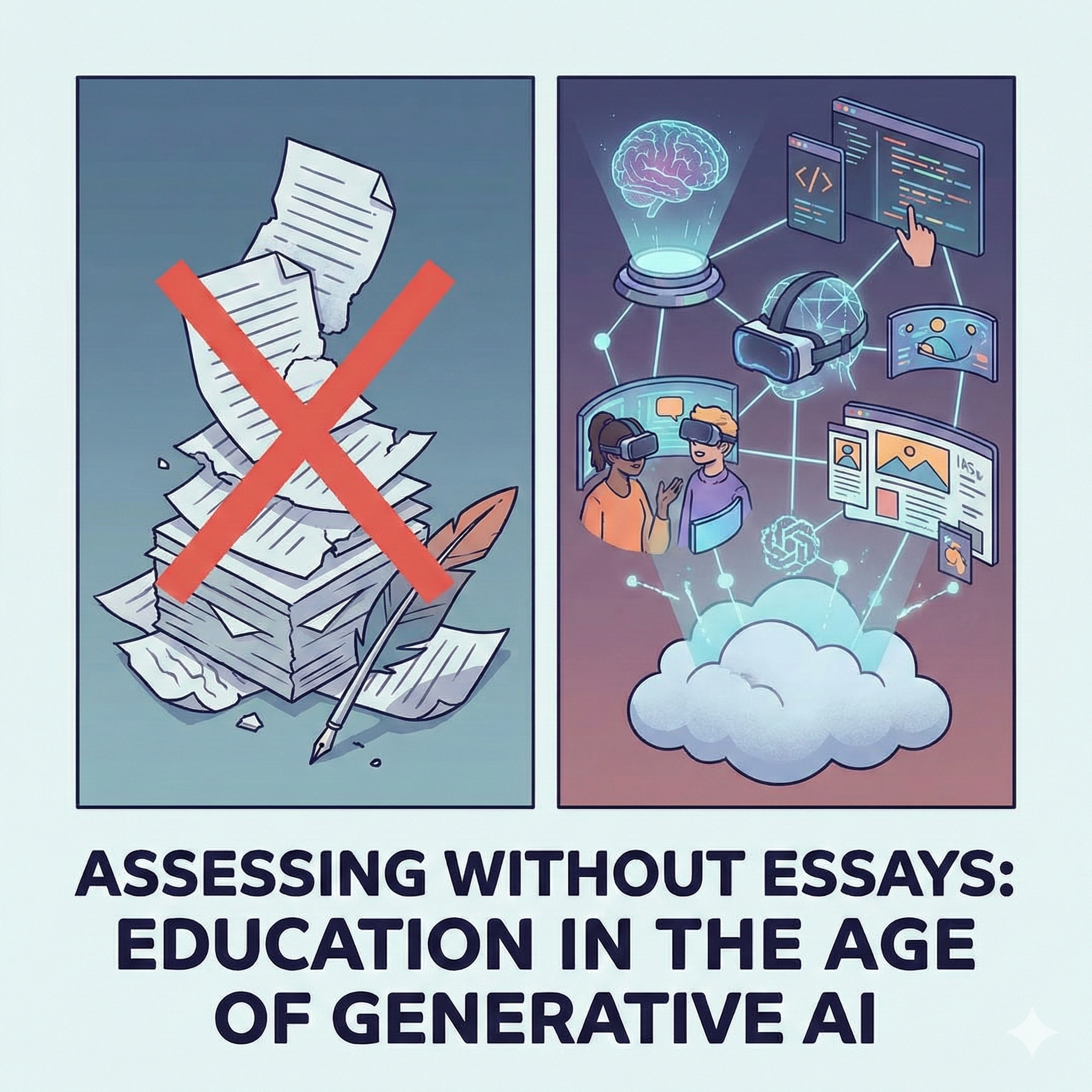
Introduction: The Educational Horizon of 2026
The year 2026 stands as a definitive watershed moment in the centuries-long history of formal education. We have crossed the threshold into a reality that was theoretically predicted but practically unprepared for: the ubiquity of high-fidelity Generative Artificial Intelligence (GenAI). The academic essay, for nearly a century the sovereign currency of student evaluation and the primary proxy for critical thinking, has collapsed as a reliable standalone metric. This is not merely a crisis of academic integrity; it is a crisis of pedagogical validity that strikes at the very heart of how human competence is defined, cultivated, and measured.
The rapid maturation of Large Language Models (LLMs) over the preceding three years has fundamentally disrupted the traditional pillars of assessment. What began in late 2022 as a novelty—a chatbot capable of writing a passable high school history paper—has evolved into a systemic integration where synthetic cognition permeates every layer of the information ecosystem. By 2026, the question facing educators is no longer if students are using AI, or even how much they are using it, but rather how educational institutions can accurately measure human learning in an ecosystem saturated with machine intelligence. The challenge is existential: if a machine can produce the output (the essay) instantly, what value remains in the human struggle to produce it? And if the output is no longer a proof of process, how do we assess the "messy middle" of learning where true cognitive growth occurs?
This report provides an exhaustive, expert-level analysis of the necessary transition away from unsupervised, text-based assessments toward more robust, authentic, and interactive modalities. We are witnessing a massive paradigm shift—a renaissance of human-centric evaluation. Specifically, this analysis charts the resurgence of Oral Exams (Viva Voce) and the aggressive expansion of Practical Projects as the new gold standards for assessment.
Drawing on comprehensive data from 2024 to 2026, including institutional case studies, emerging pedagogical frameworks like the "Ten Dimension AI Readiness Framework," and forward-looking policy documents from global bodies like TEQSA and the Digital Education Council, this report outlines a strategic roadmap. It addresses the anxieties of the "post-plagiarism" era, not by advocating for a return to analog scarcity, but by proposing a forward-thinking integration where educators developing oral exams and practical projects to counter the use of Generative AI in essay writing becomes the baseline for academic rigor.
The "Post-Plagiarism" Reality: A Statistical Landscape (2024-2026)
To understand the urgency of this transition, one must first confront the scale of the disruption. The notion of a "post-plagiarism era," a term popularized by researchers like Xiao Hu in 2025, suggests that the very definition of authorship has blurred to the point where traditional detection is futile.1 The battle to detect "cheating" through software has largely been lost; the focus must now shift to validating "learning" through interaction.
Statistical data from the 2024-2026 period paints a stark picture of a system in flux. We are observing a significant divergence between faculty perception and student reality, a gap that creates a dangerous "illusion of competence."
| Metric | Statistic (2024-2026) | Source | Context & Implications |
| Assignment Usage | ~66% of teachers report students use GenAI for assignments | 2 | This indicates that AI assistance is now the norm, not the exception. The "assignment" as a measure of individual unassisted effort is statistically invalid. |
| Exam Penetration | 31% of teachers report AI use during exams | 2 | Even in supposedly secure environments, students utilize mobile chatbots and voice features, breaching the "closed book" sanctity. |
| Content Volume | 17% of US academic content is AI-generated | 3 | Nearly one-fifth of all submitted work is synthetic. This volume overwhelms manual grading and makes "spot-checking" ineffective. |
| Discipline Rates | 64% discipline rate for AI plagiarism (up from 48%) | 3 | The punitive approach is escalating, creating an adversarial relationship between students and faculty without solving the core validity issue. |
| Faculty Anxiety | 95% fear student overreliance on AI | 4 | Almost universal concern exists regarding the erosion of critical thinking skills and the atrophy of human cognitive capability. |
| Detection Reliance | 68% of teachers rely on AI detection tools | 3 | A dangerous reliance on fallible technology. High false-positive rates risk accusing innocent students, while advanced paraphrasing tools bypass detection easily.5 |
The data reveals a "validity crisis" of staggering proportions. If 95% of faculty fear that students are over-relying on AI 4, and yet nearly 70% of those faculty are relying on detection tools that are widely acknowledged to be ineffective 3, the system is operating on a foundation of denial. The increase in disciplinary cases—jumping from 48% to 64% in a single year 3—suggests that institutions are trying to police their way out of a technological revolution, a strategy that historically fails. The disparity between the 27% of educators who admit to using AI and the 55% of students who use it highlights a "digital divide" of usage that further complicates the assessment landscape.3
The Cognitive Cost: The "Illusion of Competence"
The threat of GenAI extends far beyond the administrative headache of academic dishonesty. The primary pedagogical concern is the "illusion of competence," a phenomenon where students believe they have mastered material because they can generate a high-quality output using AI, despite lacking the underlying schema or retention of the knowledge.6 When a student prompts a model to "explain the geopolitical causes of World War I" and receives a lucid, well-structured essay, the student reads it and feels a sense of recognition. This recognition is often mistaken for understanding.
However, linguistic analysis reveals that the cognitive process of writing—the actual struggle to formulate thought—is being bypassed. Studies analyzing student essays written before and after the widespread adoption of GenAI reveal significant syntactic shifts that point to this cognitive offloading. Pre-AI essays demonstrated a greater density of verb phrases, passive voice usage, and negation—linguistic markers often associated with the mental labor of wrestling with complex concepts and formulating nuanced arguments.7
In contrast, AI-facilitated writing tends to be smoother, more uniform, and less syntactically diverse in specific human patterns. It lacks the "gerunds" and complex sentence structures that characterize deep human academic engagement.7 This "smoothing effect" masks the messy, iterative process of learning. When the "struggle" of writing—the cognitive load required to organize thoughts, select evidence, and structure arguments—is offloaded to an algorithm, the neural pathways associated with these skills are not reinforced.
Faculty fears are corroborated by survey data indicating that 90% of educators believe GenAI use diminishes critical thinking skills, and 83% perceive a decrease in student attention spans.4 This parallels the "GPS effect" in spatial navigation; just as reliance on turn-by-turn directions impairs the brain's hippocampus and spatial memory, reliance on generative text impairs the ability to structure complex arguments independently. We are risking a generation of graduates who can produce high-level analysis but cannot perform it.
Theoretical Frameworks for Assessment Reform
To address this crisis, we must move beyond "patchwork" solutions like lockdown browsers or better detection software. We require a fundamental rethinking of why and how we assess. The pivot in 2026 is driven by several key theoretical frameworks that prioritize process over product and human interaction over static submission.
The "Post-Plagiarism" Era: Redefining Academic Integrity
The concept of the "post-plagiarism era" challenges the binary view of "original vs. copied." In a world where AI can generate original-seeming work in seconds 1, plagiarism has transformed from a simple act of copying text to a complex issue of outsourcing thought.
Traditional definitions of integrity focused on attribution: "Did you write this?" The new definition must focus on capability: "Can you defend this?" Educational researchers argue that "process and critical thinking are the keys" in this new era.1 This theoretical shift draws on Assessment for Learning (AfL) principles, where assessment is seen as a pedagogical intervention rather than just a measurement tool.8
This shift necessitates a move from "policing" to "visibility." Platforms like Turnitin have acknowledged this, pivoting from simple similarity checking to providing "visibility into process".5 By tracking the evolution of a document—timestamped edits, version history, and research logs—educators can verify that a student engaged with the material over time. This approach, known as "process-based assessment," deters AI outsourcing (which typically produces completed text in large chunks) and encourages better time management.
Constructivism and Authentic Assessment
Authentic Assessment serves as the primary theoretical framework for alternatives to the essay. Defined as requiring students to "engage with a problem or task that is contextualized within a realistic environment," authentic assessment aligns with the skills required in the modern workplace.9
Key characteristics of Authentic Assessment include:
- Real-world relevance: Tasks mimic professional challenges (e.g., writing a policy memo, conducting a safety audit, designing a marketing plan).10
- Complex tasks: Problems are ill-structured and open-ended, defying the single-correct-answer format that AI solves easily.
- Iterative refinement: Students receive feedback and improve their work, mirroring professional cycles of review.11
This approach is rooted in Constructivist Theory (Piaget & Vygotsky), which posits that learners construct knowledge through experience and social interaction.12 In the context of AI, constructivism emphasizes that learning happens through the doing—the friction of solving a problem—not the having of the answer. Therefore, assessments must force the student to inhabit the problem space.
As noted in the UNESCO findings, authentic assessment in 2026 often involves Contextualized Analysis.13 Instead of assigning a standard analysis of a literary work (which ChatGPT can do instantly), educators ask students to examine how themes in a text manifest in their local community. Instead of solving generic physics problems, students analyze physical phenomena they have personally observed and documented. This hyper-localization renders GenAI less effective, as the models lack access to the specific, immediate context of the student's life or classroom environment.
Human-Centric Pedagogy: The "Double Bottom Line"
As AI becomes capable of handling routine cognitive tasks, the value of uniquely human traits—empathy, ethical reasoning, adaptability, and complex physical observation—increases. Human-Centric Pedagogy argues that assessment should focus on these differentiators.
Educational leaders advocate for a "double bottom line" approach, balancing technical proficiency with human empowerment.14 This involves designing assessments that require:
- Metacognition: Reflecting on how one thinks.
- Emotional Intelligence: Navigating complex social scenarios in role-plays.
- Physical Presence: Demonstrating skills in a verified environment.
This philosophy underpins the massive shift we are seeing toward oral exams and practical projects. It is not just about stopping cheating; it is about valuing the human element of learning that AI cannot replicate.
The Renaissance of Oral Assessment (Viva Voce)
Perhaps the most robust defense against AI-generated dishonesty, and the most pedagogically rich alternative to the essay, is the oldest form of academic assessment: the oral exam, or viva voce. Once reserved for doctoral defenses or language learning, the oral exam is being adapted for mass undergraduate education in 2026 as a scalable, high-integrity assessment method.
The "Conversational Exam": A New Standard
The modern oral exam is not a terrifying interrogation; it is a "Conversational Exam" designed to assess deep understanding. Research from 2026 demonstrates that traditional assessment methods collapse when students use GenAI, but the conversational exam restores validity by having students explain their reasoning in real-time.6
The Interactive Oral Assessment (IOA) Framework: The IOA model has emerged as a leading framework for modernizing oral exams. Unlike a rigid Q&A session, an IOA is designed as a "structured yet open conversation" based on a professional scenario.15
Key Features of the IOA Model:
- Scenario-Based: The student and assessor step into professional roles (e.g., a junior engineer briefing a site manager, a nurse handing over a patient). This lowers anxiety and frames the assessment as a professional development activity rather than a test.16
- Unscripted Interaction: While the assessor has prompts, the conversation flows naturally. This unpredictability makes it impossible for students to memorize AI-generated scripts. The assessor acts as a facilitator, using prompts like "Tell me more about..." or "What would be the implication if...".15
- Scaffolding: The assessment is not a surprise; it is the culmination of weeks of preparation. Students practice with exemplars and peers, building confidence and communication skills.15
Step-by-Step Implementation Guide for Educators
Implementing oral exams at scale requires rigorous planning. Based on the 2025/2026 user guides from institutions like DCU and CSU 16, the following workflow is recommended:
Phase 1: Pre-Assessment Design (Weeks 1-4)
- Scenario Development: Design an authentic, professional scenario. For a business class, it might be "Defend this marketing budget to the CFO."
- Rubric Design: Create a simple rubric with no more than 3-4 criteria (e.g., Knowledge Application, Professional Communication, Critical Synthesis).
- Exemplar Creation: Pre-record a sample IOA session (using a different topic) to show students exactly what is expected. This reduces anxiety significantly.
- Technology Setup: Utilize LMS schedulers to manage 10-15 minute slots. Ensure recording capability for moderation purposes.17
Phase 2: Execution (The Exam)
- Identity Verification: Verify student identity (Student ID card on camera) to prevent impersonation.
- Management: Adhere strictly to time limits (e.g., 10 minutes speaking, 5 minutes grading). Use a timer visible to the student.
- Prompting: The academic should use "redirecting" and "synthesis" prompts to probe depth. If a student recites a memorized definition, the examiner asks, "How does that apply to [specific case study]?"
Phase 3: Post-Assessment (Feedback)
- Immediate Scoring: Mark the rubric immediately after the student leaves (during the 5-minute buffer).
- Debrief: Provide a general class debrief or individual feedback via the LMS.
Solving the Scalability Crisis
A common objection to oral exams is scalability. How can one professor assess 400 students orally? Recent innovations address this "scalability bottleneck" effectively.18
- The "Conversational Exam" Efficiency: Research shows that valid oral exams can be conducted in as little as 10 minutes. By focusing on reasoning rather than content coverage (which can be assessed via automated quizzes), the time burden is managed.6
- The "Station" Approach (OSCE style): Borrowing from medical education, large classes can use a station-based approach. Students move through multiple 5-minute stations (e.g., Image Analysis, Case Defense, Theory Application), managed by different TAs or faculty members. This allows for high throughput and calibrates grading across multiple examiners.12
- Group Vivas: Assessing students in pairs or trios can reduce time requirements by 50-66%. Students discuss a problem together while the assessor observes and interjects with individual follow-up questions to verify individual contribution. This also assesses collaboration skills.12
- Voice AI Agents (The Frontier): Some institutions are experimenting with Voice AI agents to conduct the initial interview, capturing the student's spoken responses for later review by faculty.19 While controversial, this represents a potential future solution for massive scale, provided the human educator retains the final grading authority.
Case Studies: Disciplines in Practice
1. Engineering: The "Code Defense" 6 In computer science, students often use AI to generate code. To counter this, instructors implemented a "Code Defense." Students submit their code (which may be AI-assisted), but the grade depends entirely on a 5-minute live oral exam. The instructor asks the student to explain specific lines, justify logic choices, or modify a function live. If the student cannot explain the code they submitted, they receive no credit. This validates the understanding of the code, not just the code itself.
2. Medical & Health Sciences: Clinical Reasoning 12 The University of Global Health Equity implemented a structured viva format integrating basic science with clinical reasoning. Students move through stations analyzing authentic clinical scenarios. Results showed that while students found the format stressful initially, they acknowledged it eliminated the "guesswork" of multiple-choice exams and better prepared them for real clinical environments. It also provided a platform to assess professionalism and ethics—traits AI cannot demonstrate.
3. Humanities: The "Thesis Defense" 1 In history and literature, the long essay is replaced by a shorter "position paper" followed by a 10-minute defense. The instructor probes the student's interpretation of primary sources. This ensures that the student has actually read the materials and isn't just synthesizing summaries found online.
Benefits: Identity, Deep Learning, and Equity
The primary benefit of the oral exam in 2026 is Authentication. It serves as a biometric check: the student speaking must be the student who learned the material.
However, the pedagogical benefits are equally profound.
- Deep Learning: Oral exams distinguish between superficial recall and deep understanding. They allow students to "think on their feet".20
- Equity & Accessibility: For students with dyslexia or writing difficulties, oral exams can be a more accurate measure of knowledge than written tests.12 Conversely, for students with social anxiety, scaffolding and practice sessions are crucial accommodations.
- Feedback Loops: The immediate nature of the interaction allows for real-time correction of misconceptions, turning the assessment itself into a learning moment.12
Practical Projects and the "Unessay" Movement
If the oral exam replaces the exam, the practical project replaces the term paper. By requiring students to create tangible, multimodal, or highly specific artifacts, educators can bypass the text-generation capabilities of AI. This movement is often broadly termed the "Unessay."
The "Unessay": Multimodal Creativity
The "Unessay" movement challenges students to demonstrate their learning through their medium of choice, provided it meets the rigorous academic criteria of the course. This leverages student agency—a powerful intrinsic motivator that reduces the desire to cheat.21
Examples of "Unessay" Formats:
- Podcasts & Documentaries: Students research a historical event and produce a 10-minute scripted audio or video documentary. While AI can write a script, the production value, editing, voice acting, and synthesis of audio sources require human executive function and artistic judgment.22
- Infographics & Data Visualization: Converting complex data into visual narratives requires a level of synthesis and design thinking that current text-based LLMs struggle to automate fully.23
- Digital Storytelling: Combining text, image, and interactivity to narrate a case study. Tools like Twine or specialized digital storytelling platforms allow students to create non-linear narratives that demonstrate complex causal reasoning.23
Digital Humanities and Public History
In the humanities, fields often most threatened by AI writing, the shift is toward Public History and Digital Humanities (DH). These projects often involve creating resources for the public rather than for the professor, raising the stakes and the requirement for accuracy.
Curated Digital Archives & Local History 24: Students are tasked with digitizing and annotating local historical documents, family artifacts, or community records.
- Why it works: AI models are trained on the internet's "general" knowledge. They do not know the contents of a specific box of letters in a local town hall or a student's grandmother's attic. This "archival silence" in the AI dataset is the perfect space for student research.
- Example: A history class visiting local memorials or museums to critique public memory, then building a website to present their findings.24
Web Blogs & Public Scholarship 26: Instead of a private essay, students maintain a public-facing blog analyzing course themes. The public nature of the work often increases student accountability. Peer review serves as a secondary check, as students engage with each other's public work.
Authentic Simulations in Business and Science
For professional degrees, assessments are moving toward high-fidelity simulations that mimic the complexity of the workplace.
Business: The Living Case Study 10
- The Scenario: Students manage a mock investment portfolio or develop a business plan for a real local company over a semester.
- AI Resilience: The assessment is based on the rationale for decisions made in response to real-time, unfolding news events. A static AI prompt cannot manage a dynamic, semester-long strategy that requires reacting to yesterday's market shift.
- Role Play: Students role-play counseling sessions or client negotiations. These are recorded and critiqued for emotional intelligence and tactical communication.10
Science: The "Lab Vlog" and Field Journal 28
- The Shift: Traditional lab reports are easily faked. The "Lab Vlog" requires students to document their physical experiments through video.
- Field Studies: In geography or ecology, students document field studies investigating local features. They must capture geo-tagged photos, collect physical samples, and analyze data specific to that exact location and time.28 An AI cannot hallucinate a soil sample from a specific GPS coordinate that matches the local weather conditions of that day.
Assessing the "Messy Middle": Process Over Product
A unifying theme across all practical projects is the assessment of the "messy middle." We must stop grading only the final artifact and start grading the evolution of the idea.
Strategies for Process Assessment:
- Version History Audits: Using platforms like Google Docs or specialized LMS tools to visualize the writing process. Large copy-pastes are flagged for discussion. This "forensic" approach validates the time spent on the task.5
- Reflective Journaling: Students must write weekly reflections on their challenges, changes in direction, and learning breakthroughs. These metacognitive pieces are difficult to forge convincingly because they are deeply personal and idiosyncratic. They require the student to analyze their own thinking.23
- Annotated Bibliographies with Methodology: Students must explain how they found their sources and why they selected them. This validates the research trail.23
AI as a Collaborator: Hybrid Assessment Models
The goal of assessment reform is not to ban AI entirely—a futile and counterproductive endeavor—but to integrate it safely and effectively. By 2026, leading institutions have moved to "Hybrid Assessment" where AI is treated as a teammate or a tool to be critiqued. This prepares students for a workforce where human-AI collaboration is the norm.
The "Sandwich" Method of Assessment
This model integrates AI into the workflow while preserving human oversight at critical junctures.
- Step 1 (Human): Initial ideation, outlining, and thesis generation. This is done in-class or via an oral pitch to ensure the original thought belongs to the student.
- Step 2 (AI Assisted): The student uses AI to generate drafts, brainstorm counter-arguments, or summarize vast amounts of research. The student must log their prompts and the AI's output.30
- Step 3 (Human): Final synthesis, voice calibration, fact-checking, and ethical review. The student submits the final product along with an "AI Appendix" detailing their interaction with the tool.
AI as "Sparring Partner" or "Critique Object"
The AI Debater 30: Students are assigned to debate a topic against an AI. The assessment is not the debate itself, but the student's annotated transcript of the debate. They must identify the AI's logical fallacies, biases, and hallucinations. This builds high-level critical thinking skills.
The Reverse Turing Test:
Students generate an essay using AI, then use "Track Changes" to critique and improve it. The grade is based on the quality of the critique—the "delta" between the AI's generic output and the student's refined, insightful final version. This teaches students that AI is a baseline, not a ceiling.
Institutional Readiness and Future Scenarios
Implementing these changes requires more than just individual teacher enthusiasm; it requires systemic institutional readiness.
The "Ten Dimension AI Readiness Framework" (DEC 2025)
The Digital Education Council (DEC) released a comprehensive framework in 2025 to guide institutions.31 Educators and administrators must evaluate their readiness across these ten dimensions to successfully transition to non-essay assessment:
| Dimension | Key Focus for Assessment Reform |
| 1. Strategic Alignment | Is assessment reform part of the core mission, or an add-on? |
| 2. Institutional Governance | Who owns the policy? (Shift from IT to Academic Affairs). |
| 3. Stakeholder Engagement | Are students and faculty co-designing the new assessments? |
| 4. Operational Readiness | Do we have the scheduling tools and rooms for oral exams? |
| 5. AI Literacy | Are faculty trained to conduct valid oral exams? |
| 6. Accessibility & Inclusion | Do oral exams disadvantage neurodivergent students? (Need for accommodations). |
| 7. Professional Development | Training faculty in "process-based" grading. |
| 8. Teaching & Learning Strategy | Moving from "content delivery" to "facilitation." |
| 9. Curriculum Alignment | Does the curriculum teach skills AI cannot do? |
| 10. Research & Innovation | Using data to iterate on assessment validity. |
Six Near-Future Scenarios (Chalmers Study 2025)
A landmark study by Chalmers University outlines "Six Near-Future Scenarios" for higher education, helping leaders anticipate the challenges of this transition.33
- Conflicting Learning Goals: The tension between "basics" (which AI can do) and "deep thinking." Institutions may struggle to define what is "foundational" when AI automates the foundation.
- Excessive Self-Direction: As students use AI to self-tutor, they may disengage from the curriculum. Assessment must pull them back into the community.
- Unpredictable GenAI Development: Tools change faster than 4-year degree programs. Assessment strategies must be "medium-agnostic" (e.g., oral defense works regardless of GPT-5 or GPT-6).
- Contradictory Regulations: A patchwork of bans and mandates creates confusion. Institutions need a unified "AI Constitution."
- Changing Educator Roles: Teachers move from "content deliverers" to "learning architects" and "mentors." This is the most critical shift. The educator becomes a coach who observes the process.35
- The Forging of an AI-Ready Campus: Successful institutions create robust support systems (AI tutors, sandbox environments) that allow for safe experimentation.35
Conclusion: Re-Humanizing Education
The disruption caused by Generative AI in education is irreversible. The "essay crisis" is not a temporary glitch but a signal that the industrial model of education—standardized, text-based, and output-focused—is no longer viable.
The research and data from 2024-2026 clearly indicate that the path forward lies in re-humanizing assessment. By embracing Oral Exams, educators can verify authenticity and deepen communicative competence. By shifting to Practical Projects, institutions can align academic work with real-world complexities that algorithms cannot yet master. By adopting Process-Based Assessment, we value the journey of learning over the destination.
This transition is resource-intensive. It requires smaller class sizes, more teaching assistants, and more time for grading. However, the alternative is the obsolescence of the educational credential. If a degree signifies nothing more than the ability to prompt a chatbot, it holds no value.
Ultimately, the goal of assessment in the Age of AI is not to prove that a student can write better than a machine, but to prove that the student can think in ways the machine cannot. As we look toward 2027, the most successful educational systems will be those that measure the uniquely human capacity for critical inquiry, ethical reasoning, and creative application in a world augmented by artificial intelligence.
References and Data Sources
- For statistical data on AI usage and plagiarism:.2
- For linguistic analysis of student vs. AI writing:.7
- For Oral Exam/Viva Voce methodologies and benefits:.6
- For authentic assessment and project-based learning:.9
- For future scenarios and institutional frameworks:.31
- For human-centric and process-based pedagogy:.1
- For Digital Humanities and Public History examples:.24
- For AI-integrated assessment strategies:.30
Works cited
- Assessment in the AI Era: Grade the thinking, not just the text | University of Arizona News, diakses Januari 28, 2026, https://news.arizona.edu/employee-news/assessment-ai-era-grade-thinking-not-just-text
- The Latest AI in Education Statistics (2026) - Programs.com, diakses Januari 28, 2026, https://programs.com/resources/ai-education-statistics/
- AI Plagiarism Statistics 2025: Transforming Academic Integrity - Artsmart.ai, diakses Januari 28, 2026, https://artsmart.ai/blog/ai-plagiarism-statistics/
- National Survey: 95% of College Faculty Fear Student… | AAC&U, diakses Januari 28, 2026, https://www.aacu.org/newsroom/national-survey-95-of-college-faculty-fear-student-overreliance-on-ai-and-diminished-critical-thinking-among-learners-who-use-generative-ai-tools
- BETT 2026: Turnitin warns assessment models must evolve as AI use accelerates, diakses Januari 28, 2026, https://www.edtechinnovationhub.com/news/bett-2026-turnitin-warns-assessment-models-must-evolve-as-ai-use-accelerates
- The Conversational Exam: A Scalable Assessment Design for the AI Era - arXiv, diakses Januari 28, 2026, https://arxiv.org/html/2601.10691v1
- How Generative AI Is Reshaping Student Writing: A Data-Driven Perspective for Writing Instructors - MDPI, diakses Januari 28, 2026, https://www.mdpi.com/2227-7102/16/1/1
- Assessment reform for the age of artificial intelligence - UQ eSpace - The University of Queensland, diakses Januari 28, 2026, https://espace.library.uq.edu.au/view/UQ:fa2ac34/UQfa2ac34_OA.pdf
- What is authentic assessment? A full guide for educators, diakses Januari 28, 2026, https://feedbackfruits.com/blog/what-is-authentic-assessment-a-full-guide-for-educators
- Assess Student Learning Using Authentic Assessments | The Office of Learning Technologies - The University of Alabama at Birmingham, diakses Januari 28, 2026, https://www.uab.edu/elearning/news/faculty-best-practices-news/assess-student-learning-using-authentic-assessments
- Authentic Assessments | Center for the Advancement of Teaching Excellence, diakses Januari 28, 2026, https://teaching.uic.edu/cate-teaching-guides/assessment-grading-practices/authentic-assessments/
- The viva voce innovation and experience at a new medical school in ..., diakses Januari 28, 2026, https://pmc.ncbi.nlm.nih.gov/articles/PMC12210533/
- What's worth measuring? The future of assessment in the AI age - UNESCO, diakses Januari 28, 2026, https://www.unesco.org/en/articles/whats-worth-measuring-future-assessment-ai-age
- Leading with purpose: Why human-centric strategies are vital in the AI era, diakses Januari 28, 2026, https://www.weforum.org/stories/2025/01/leading-with-purpose-why-human-centric-strategies-are-vital-in-the-ai-era/
- Interactive oral assessment (IOA) - The University of Melbourne, diakses Januari 28, 2026, https://www.unimelb.edu.au/tli/learning-design-and-assessment/assessment-and-feedback/interactive-oral-assessment
- Interactive Oral Assessments User Guide - Charles Sturt University, diakses Januari 28, 2026, https://cdn.csu.edu.au/__data/assets/pdf_file/0003/4352061/Interactive-Oral-Assessments-User-Guide.pdf
- Interactive Oral (IO) User Guide - DCU, diakses Januari 28, 2026, https://www.dcu.ie/sites/default/files/inline-files/interactive-oral-io-user-guide.pdf
- Professr: Scaling oral assessment through AI (Oct 16, 2025) - YouTube, diakses Januari 28, 2026, https://www.youtube.com/watch?v=fTw4g_izYeg
- Fighting Fire with Fire: Scalable Personalized Oral Exams with an ElevenLabs Voice AI Agent - A Computer Scientist in a Business School, diakses Januari 28, 2026, https://www.behind-the-enemy-lines.com/2025/12/fighting-fire-with-fire-scalable-oral.html
- Viva voce - Division of Learning and Teaching - Charles Sturt University, diakses Januari 28, 2026, https://www.csu.edu.au/division/learning-teaching/assessments/assessment-types/viva-voce
- Alternatives to Traditional Essays - UVA Teaching Hub - The University of Virginia, diakses Januari 28, 2026, https://teaching.virginia.edu/collections/alternatives-to-traditional-essays
- Rethinking assessment strategies in the age of artificial intelligence (AI) - Division of Learning and Teaching - Charles Sturt University, diakses Januari 28, 2026, https://www.csu.edu.au/division/learning-teaching/assessments/assessment-and-artificial-intelligence/rethinking-assessments
- Alternative Assessments to High Stakes Exams | University of North Dakota, diakses Januari 28, 2026, https://und.edu/academics/ttada/alternative-assessments.html
- Public History Projects - Bellarmine College of Liberal Arts, diakses Januari 28, 2026, https://bellarmine.lmu.edu/history/beyondtheclassroom/publichistoryprojects/
- HIST 106 Course-Level Assessment Project Final Report - Carroll Community College, diakses Januari 28, 2026, https://www.carrollcc.edu/wp-content/uploads/HIST-106-History-of-the-U.S.-since-1876-Spring-2022-web.pdf
- (PDF) Web blog as an alternative assessment for humanities: an exploratory case study, diakses Januari 28, 2026, https://www.researchgate.net/publication/394214740_Web_blog_as_an_alternative_assessment_for_humanities_an_exploratory_case_study
- Full article: Educationally authentic assessment: reframing authentic assessment in relation to students' meaningful engagement - Taylor & Francis, diakses Januari 28, 2026, https://www.tandfonline.com/doi/full/10.1080/13562517.2024.2394042
- Rethinking Assessment for Generative AI: Beyond the Essay, diakses Januari 28, 2026, https://rethinkingassessment.com/rethinking-blogs/rethinking-assessment-for-generative-ai-beyond-the-essay/
- Examples of Authentic Assessment in Different Subjects - Digital Education Support Resources - University of Lincoln, diakses Januari 28, 2026, https://digitaleducation.lincoln.ac.uk/examples-of-authentic-assessment-in-different-subjects/
- 4 Simple Ways to Integrate AI into Your Class | Harvard Business Impact Education, diakses Januari 28, 2026, https://hbsp.harvard.edu/inspiring-minds/4-simple-ways-to-integrate-ai-into-your-class
- Ten Dimension AI Readiness Framework - Digital Education Council, diakses Januari 28, 2026, https://www.digitaleducationcouncil.com/post/ten-dimension-ai-readiness-framework
- 10 dimensions of AI readiness - eCampus News, diakses Januari 28, 2026, https://www.ecampusnews.com/ai-in-education/2025/06/24/10-dimensions-of-ai-readiness/
- Navigating generative AI in higher education – six future scenarios, diakses Januari 28, 2026, https://research.chalmers.se/publication/548587/file/548587_Fulltext.pdf
- Foresight: How AI Will Transform Higher Education - Chalmers, diakses Januari 28, 2026, https://www.chalmers.se/en/current/news/foresight-how-ai-will-transform-higher-education/
- Full article: Navigating generative AI in higher education – six near future scenarios, diakses Januari 28, 2026, https://www.tandfonline.com/doi/full/10.1080/17439884.2025.2562405
- New Data Reveal How Many Students Are Using AI to Cheat - Education Week, diakses Januari 28, 2026, https://www.edweek.org/technology/new-data-reveal-how-many-students-are-using-ai-to-cheat/2024/04
- Using Oral Assessments to Enrich Our Understanding of Student Learning - Edutopia, diakses Januari 28, 2026, https://www.edutopia.org/article/benefits-oral-assessments-2-ways-do/
- Alternatives to Traditional Exams and Papers - Center for Innovative Teaching & Learning, diakses Januari 28, 2026, https://citl.indiana.edu/teaching-resources/assessing-student-learning/alternatives-traditional-exams-papers/index.html
- Case Studies and Examples for Evaluating Digital Scholarship - College Art Association, diakses Januari 28, 2026, https://www.collegeart.org/news/2016/02/23/case-studies-and-examples-for-evaluating-digital-scholarship/
- The Next Era of Assessment: A Global Review of AI in Assessment Design, diakses Januari 28, 2026, https://www.digitaleducationcouncil.com/post/the-next-era-of-assessment-a-global-review-of-ai-in-assessment-design
0 Comments