
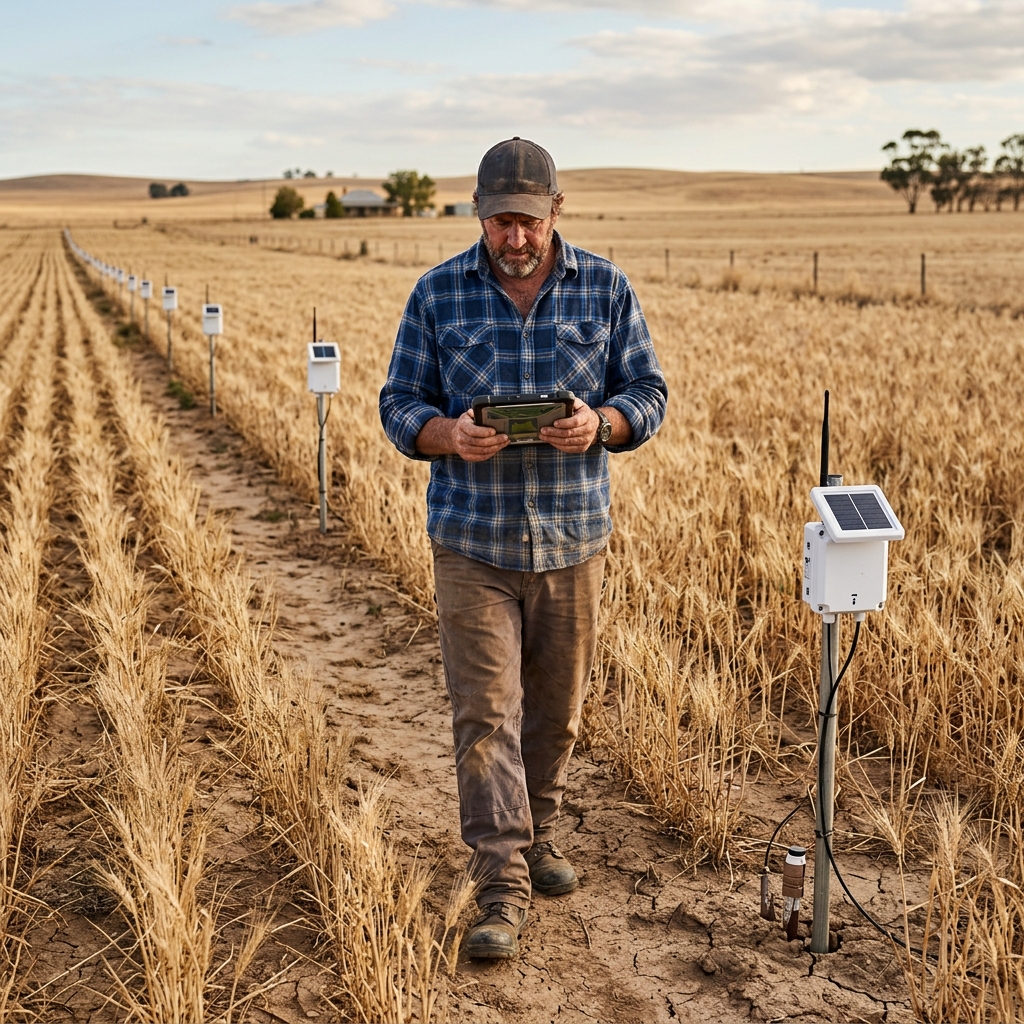
Optimizing Irrigation in Arid Regions: An Empirical Investigation into IoT-Based Soil Moisture Sensor Networks for Precision Agriculture
Introduction
Background and Rationale
The imperative to maximize agricultural output while minimizing resource consumption has driven the advent of precision agriculture, a paradigm that is particularly critical in arid and semi-arid regions. In these geoclimatic zones, water scarcity poses an existential threat to crop viability and food security, exacerbated by the accelerating impacts of global climate change and the depletion of subterranean aquifers. Concurrently, the proliferation of the Internet of Things (IoT) has introduced unprecedented capabilities into modern agricultural frameworks. IoT technology—characterized by interconnected networks of physical devices capable of collecting, transmitting, and analyzing vast quantities of environmental data—facilitates a transition from empirical, intuition-based farming to data-driven agronomic management. Within this context, the necessity for optimizing irrigation practices is paramount. Traditional, uniform irrigation protocols often lead to systemic inefficiencies, including both under-watering, which induces crop stress and yield penalties, and over-watering, which results in nutrient leaching, soil salinization, and the rapid depletion of finite water resources. Integrating hyper-localized, real-time data is therefore essential for sustainable agricultural intensification (Belinda et al., 2025).
Objectives of the Study
The primary aim of this proposed study is to systematically implement and empirically evaluate the efficacy of IoT-based soil moisture sensor networks in regulating and optimizing irrigation schedules within arid agricultural environments. To achieve this, the research is guided by several specific questions and hypotheses. Primarily, the study hypothesizes that the deployment of automated, IoT-driven irrigation systems will yield a statistically significant reduction in total water volumetric usage compared to traditional, timed irrigation schedules, without a concomitant reduction in crop yield. The central research questions include: How does high-frequency, real-time soil matric potential data alter localized irrigation scheduling? Furthermore, what is the exact correlation between granular soil moisture management and crop physiological performance in high-evapotranspiration environments? The expected impact of this research is highly significant, aiming to definitively demonstrate that localized sensor networks can substantially elevate agricultural productivity while acting as a vital conservation tool for global freshwater supplies (Varathaiah et al., 2024).
Literature Review
Overview of Precision Agriculture
Precision agriculture represents a comprehensive systems approach to farm management, leveraging information technology to ensure that crops and soil receive exactly what they need for optimum health and productivity. The literature highlights core concepts such as the identification and management of spatial and temporal variability within fields, utilizing technologies ranging from Geographic Information Systems (GIS) to remote sensing via satellite or Unmanned Aerial Vehicles (UAVs). Previous studies evaluating precision irrigation have predominantly focused on macro-level evapotranspiration (ET) models and historical weather data to inform scheduling. While these methodologies have improved upon blanket irrigation techniques, critical gaps remain in the current research corpus. Specifically, existing literature lacks extensive longitudinal studies detailing the efficacy of highly granular, real-time subterranean data integration—particularly in deeply arid contexts where micro-variations in soil hydrology can drastically dictate crop survival and yield (Thorp et al., 2022).
IoT in Agriculture
The application of IoT technologies in agriculture has fundamentally transformed the capture and utilization of environmental data. Scholarly reviews of IoT in agronomy detail its expansive application across various domains, including microclimate monitoring, predictive crop disease modeling, and the orchestration of automated farm machinery. The benefits of IoT-based systems are profound, offering high-resolution data acquisition, reduced labor costs, and the facilitation of proactive decision-making. However, the literature also outlines significant challenges, particularly concerning rural deployment: the limitations of bandwidth, the necessity for ultra-low-power wide-area networks (LPWAN) like LoRaWAN, and the harsh environmental degradation of sensitive electronic components. Despite these hurdles, successful IoT implementations have been documented, notably in the Mediterranean basin and the Australian outback, where pilot programs utilizing dispersed soil telemetry have reported substantial efficiency gains, thereby validating the foundational premise of applying wireless sensor networks to water management (Johnson, 2025).
Methodology
Research Design
This study will employ a quantitative, experimental field research design, specifically utilizing a Randomized Complete Block Design (RCBD) to control for inherent spatial variability in soil composition and topography. The experimental design will contrast a control group—subjected to conventional, timer-based irrigation methods standard to the region—against experimental plots governed dynamically by an automated IoT sensor network. The study sites will be meticulously selected within distinctly arid agricultural zones, characterized by less than 250 mm of annual precipitation, high atmospheric evaporation demand, and sandy-loam soil profiles which exacerbate rapid drainage. The research timeline is structured over a comprehensive 24-month period. This encompasses a three-month pre-deployment phase for hardware calibration and baseline establishment, two complete growing seasons to capture inter-annual climatic variations, and a final three-month post-harvest phase dedicated to exhaustive data synthesis and statistical modeling (Belkher et al., 2025).
Data Collection
The data collection architecture is designed to capture a multifaceted profile of the agro-ecological environment. Primary data will consist of continuous volumetric water content (VWC) and soil matric potential measurements. Additionally, the network will record localized soil temperature, electrical conductivity (to monitor salinity accumulation), and ambient microclimate data (humidity, solar radiation). The deployment will utilize robust, industrial-grade capacitance sensors placed at multiple stratified depths within the crop root zone to map the water infiltration profile. Data acquisition will be facilitated through a wireless sensor network utilizing a LoRaWAN communication protocol, transmitting packets hourly to a centralized edge-computing gateway. From there, the data will be pushed to a secure, cloud-based repository. System monitoring will be executed via a customized digital dashboard, allowing researchers to observe real-time data streams and verify sensor calibration status continuously (Gasch et al., 2017).
Data Analysis
The analytical framework will utilize rigorous statistical methodologies to interpret the vast datasets generated by the sensor network. Initial data processing will involve time-series analysis to identify diurnal and seasonal moisture trends. To evaluate the primary hypothesis, a repeated-measures Analysis of Variance (ANOVA) will be employed to compare water consumption volumes and final crop yield metrics (e.g., biomass, grain weight) between the control and experimental blocks. The data will be actively utilized to optimize irrigation practices by establishing dynamic, algorithm-driven irrigation thresholds; water will be applied strictly when the soil moisture approaches the specific Permanent Wilting Point (PWP) of the cultivated crop, thereby eliminating extraneous watering. To ensure scientific rigor, the automated sensor data will be periodically validated against destructive, gravimetric soil sampling and cross-referenced with crop stress indicators derived from multispectral drone imagery, such as the Normalized Difference Vegetation Index (NDVI) (Posada et al., 1991).
Expected Outcomes and Impact
Anticipated Results
Based on preliminary extrapolations, it is anticipated that the experimental plots governed by the IoT framework will demonstrate a 20% to 30% reduction in total volumetric water application relative to the control plots. Concurrently, we predict that these improvements in irrigation efficiency will not only maintain but potentially enhance crop yield. By precisely maintaining soil moisture within the optimal physiological window, the system is expected to mitigate transient drought stress and reduce the leaching of vital nitrogen-based fertilizers below the root zone. The broader implications of these results for sustainable agriculture are profound. Demonstrating that significant water conservation can be decoupled from yield penalties provides a critical, empirically backed blueprint for policy-makers, water management authorities, and farming communities striving to adapt to increasing hydrological volatility (Arjun & R, 2024).
Contribution to the Field
This research will significantly advance the field of precision agriculture by providing high-fidelity, longitudinal data validating the economic and agronomic viability of large-scale IoT networks in challenging environments. The findings are expected to transition theoretical models of automated irrigation into practical, field-tested reality. Furthermore, the principles and algorithms developed herein hold immense potential for application in other geoclimatic regions, particularly semi-arid or temperate zones newly experiencing severe, climate-change-induced drought cycles. Beyond agronomy, this study contributes tangibly to the development of IoT technology itself. By stress-testing sensor arrays, edge-computing algorithms, and low-power communication protocols in harsh, high-temperature, and high-dust environments, the research will yield valuable engineering data that can inform the next generation of robust, agricultural-grade hardware and software architectures (Kasereka et al., 2025).
Budget and Resources
Funding Requirements
The successful execution of this comprehensive study necessitates a robust funding mechanism. The estimated budget is fundamentally divided into capital expenditures (CapEx) and operational expenditures (OpEx). CapEx includes the procurement of industrial-grade soil moisture probes, environmental sensors, LoRaWAN gateways, solar-powered battery arrays, and the necessary servers for secure data storage. OpEx encompasses the costs associated with recurring software licensing, cloud hosting fees, routine hardware maintenance, and logistical travel to the remote arid study sites. Funding is actively being sought through a consortium of sponsors, targeting federal and state agricultural departments, international environmental NGOs focused on water conservation, and private technology grants dedicated to fostering innovations in the "AgTech" sector (Humiston, 2016).
Resource Allocation
Strategic resource allocation is critical to maintaining the fidelity of the experimental design. The personnel roster will include lead academic researchers responsible for project oversight and statistical analysis, dedicated field technicians tasked with the physical deployment and calibration of the sensor networks, and data scientists to manage the cloud infrastructure and machine learning algorithms. Crucially, the project mandates close collaboration with local agronomic experts who possess profound, localized knowledge of the selected arid zones. To ground the research in practical reality, the study will operate in direct partnership with local farming cooperatives. These stakeholders will provide the necessary land access and, importantly, invaluable qualitative feedback regarding the user-friendliness and practical viability of integrating advanced IoT dashboards into daily farm management workflows (Kantar et al., 2025).
Conclusion
Summary of Proposal
In summary, this research proposal outlines a rigorous, empirical investigation into the transformative potential of IoT-based soil moisture sensor networks for optimizing irrigation in arid regions. By bridging the gap between advanced wireless telemetry and fundamental agronomic science, the study aims to definitively quantify the water-saving and yield-protecting benefits of highly granular, real-time data integration. The innovative aspect of this research lies not merely in the deployment of sensors, but in the creation of a closed-loop, automated decision-making framework that completely removes the inefficiencies of traditional, intuition-based irrigation scheduling. Ultimately, this research seeks to catalyze a paradigm shift in precision agriculture practices, providing a scalable model for resilience in regions facing acute hydrological crises.
Future Research Directions
The culmination of this study will inherently generate new pathways for scientific inquiry. Future research directions should prioritize the integration of ground-based IoT sensor data with macroscopic datasets, such as meteorological satellite feeds and AI-driven weather forecasting models, to create predictive—rather than merely reactive—irrigation algorithms. Additionally, there is significant potential for investigating the scalability of this technology, adapting the network architecture for deployment across massive, industrial-scale agricultural operations in diverse global regions. Ultimately, the continued, aggressive pursuit of research at the intersection of IoT and agriculture remains an absolute necessity; it is the most promising technological avenue for reconciling the escalating global demand for food with the urgent ecological imperative to conserve our planet's diminishing freshwater resources.
References
Arjun, B., & R, D. K. (2024). IoT in Drip Irrigation: Revolutionizing Sustainable Agriculture. International Journal of Research Publication and Reviews, 5(3), 462–466. https://doi.org/10.55248/gengpi.5.0324.0616
Belinda, C. M., Kannan, E., Sivagami, S., & James, J. W. (2025). Enhancing precision farming through IoT (pp. 50–68). Crc. https://doi.org/10.1201/9781032618173-5
Belkher, S., Latrech, B., Bekri, W., Markwordt, F., Rahim, M. A., Dupont, C., Ben Abdallah, M. A., Daghari, H., & Rezig, M. (2025). Deficit Irrigation and an IoT-Based System for Improving Yield and Water Use Efficiency of Winter Wheat Grown Under Semi-Arid Conditions. Agronomy, 15(1), 157. https://doi.org/10.3390/agronomy15010157
Gasch, C. K., Brown, D. J., Campbell, C. S., Cobos, D. R., Brooks, E. S., Chahal, M., & Poggio, M. (2017). A Field‐Scale Sensor Network Data Set for Monitoring and Modeling the Spatial and Temporal Variation of Soil Water Content in a Dryland Agricultural Field. Water Resources Research, 53(12), 10878–10887. https://doi.org/10.1002/2017wr021307
Humiston, G. (2016). Public funding for agricultural research benefits us all. California Agriculture, 70(2), 52. https://doi.org/10.3733/ca.v070n02p52
Johnson, M. (2025). The Role of IoT in Precision Agriculture: Improving Yields and Reducing Costs. American Journal Of Internet Of Things, 6(4), 1–5. https://doi.org/10.71465/ajiot3414
Kantar, M., Ewing, P., Bančič, J., Fumia, N., Garba, I., Jamshidi, S., Jannink, J., Jha, P., Jungers, J., Pathak, H., Paul, S. S., Raghavan, B., Runck, B., Singh, J., Subedi, S., Joshi, V., & Wang, D. (2025). Computational design for more engaged, impactful, and dynamic agricultural research. Crop Science, 65(2). https://doi.org/10.1002/csc2.70034
Kasereka, S. K., Tashev, T., Medagbe, Y.-C. N., Ocama, O. V., Ilunga, G. W. K., Kyungu, E., & Kyamakya, K. (2025). Smart Irrigation for Precision Agriculture: A Pathway to Sustainable Farming in Low-Income Regions. 1–9. https://doi.org/10.1109/bdkcse67969.2025.11300531
Posada, J. F., Liou, J. J., & Miller, R. N. (1991). An automated data acquisition system for modeling the characteristics of a soil moisture sensor. IEEE Transactions on Instrumentation and Measurement, 40(5), 836–841. https://doi.org/10.1109/19.106307
Thorp, K. R., Calleja, S., Pauli, D., Thompson, A. L., & Elshikha, D. E. (2022). Agronomic Outcomes of Precision Irrigation Management Technologies with Varying Complexity. Journal of the ASABE, 65(1), 135–150. https://doi.org/10.13031/ja.14950
Varathaiah, D., Yogarayan, S., Mae, A. E., & Min, P. P. (2024). IoT-Driven Soil Moisture Monitoring for Optimizing Irrigation. 1066–1071. https://doi.org/10.1109/icicyta64807.2024.10913339
0 Komentar