
Assessing Consumer Emotional Responses to AI-Generated Advertising Visuals: A Neuromarketing Approach Utilizing EEG and Eye-Tracking
Introduction
Background and Rationale
The contemporary advertising landscape is undergoing a profound transformation driven by the rapid proliferation of artificial intelligence (AI). Specifically, generative AI technologies have fundamentally altered the production of marketing stimuli, enabling the instantaneous creation of highly realistic, tailored, and diverse advertising visuals. Consequently, there is an urgent need to understand how these synthetic, machine-generated visual elements impact consumer behavior compared to traditional, human-crafted media. Central to consumer behavior is the evocation of emotional responses, which serve as foundational drivers for brand attitude formulation, memory encoding, and ultimate purchase intent. Historically, measuring these emotional responses has relied heavily on self-reported measures, which are often subject to cognitive bias, social desirability, and post-rationalization. To circumvent these limitations, the discipline of neuromarketing has emerged as a critical methodological paradigm. By applying neuroscientific methods to consumer research, neuromarketing bypasses conscious cognitive filtering, allowing researchers to capture objective, physiological manifestations of affective states. In the context of AI-generated advertising, deploying neuromarketing tools provides unparalleled, granular insights into how these novel visual stimuli implicitly engage the consumer’s cognitive and emotional processing centers (Saha, 2025).
Research Objectives
The primary objective of this study is to empirically investigate and quantify the implicit emotional and cognitive responses of consumers when exposed to AI-generated advertising visuals compared to traditional human-created visuals. To achieve this, the study leverages Electroencephalography (EEG) and eye-tracking technology. The significance of employing these specific methodologies lies in their complementary nature: EEG provides high-temporal-resolution data regarding cortical arousal, affective valence, and cognitive load, while eye-tracking elucidates visual attention, overt cognitive interest, and specific fixation points on the advertising stimuli. Synthesizing these data streams allows for a robust, multidimensional analysis of consumer interaction. The study is guided by three primary research questions: (1) How do the emotional valence and cognitive load elicited by AI-generated visuals differ from those elicited by traditional advertising visuals, as measured by EEG? (2) What are the distinct visual attention patterns (e.g., fixation duration, saccadic pathways) associated with AI-generated content? (3) Is there a significant correlation between the implicit neurophysiological responses to AI-generated visuals and subsequent explicit brand recall and purchase intent? We hypothesize that AI-generated visuals, particularly those exhibiting uncanny valley characteristics, will elicit divergent patterns of frontal asymmetry (valence) and increased visual search behavior compared to traditional counterparts (Matukin et al., 2016).
Literature Review
AI-Generated Advertising Visuals
The integration of generative AI in marketing has catalyzed a burgeoning body of literature focused on the intersection of algorithmic generation and creative output. Existing scholarship highlights that generative adversarial networks (GANs) and diffusion models have substantially lowered the barriers to content creation, offering marketers unprecedented scalability, cost-efficiency, and hyper-personalization capabilities. However, the literature also delineates significant challenges, primarily concerning the semantic authenticity, ethical implications, and the phenomenon of the “uncanny valley”—where highly realistic but slightly imperfect artificial human representations evoke feelings of eeriness or revulsion. Consumer perception studies indicate a complex dichotomy: while some consumers appreciate the novelty and aesthetic appeal of AI-generated art, others exhibit algorithm aversion, demonstrating a persistent preference for human-authored content perceived to possess genuine emotional resonance and intentionality. The current academic discourse lacks consensus on how these polarized perceptions translate into spontaneous, physiological emotional arousal when consumers are passively exposed to such advertisements (Raut et al., 2024).
Neuromarketing Techniques
Neuromarketing represents the confluence of neuroscience, psychology, and marketing, aiming to decode the subconscious physiological processes that precede overt consumer decision-making. Standard methodologies within this domain include functional Magnetic Resonance Imaging (fMRI), galvanic skin response (GSR), electrocardiography (ECG), EEG, and eye-tracking. Among these, EEG is highly valued for its exceptional temporal resolution and portability, allowing researchers to track millisecond-by-millisecond fluctuations in brain wave frequencies (Alpha, Beta, Theta, Gamma) that correlate with specific mental states such as attention, engagement, and emotional valence (often measured via frontal alpha asymmetry). Concurrently, eye-tracking relies on the “eye-mind hypothesis,” positing that overt visual attention is inextricably linked to cognitive processing. Metrics such as fixation duration, pupil dilation, and scan paths provide direct evidence of visual salience and information processing strategies. Previous empirical studies have successfully utilized the concomitant application of EEG and eye-tracking to evaluate website usability, packaging design, and video advertising efficacy. However, there is a pronounced lacuna in applying this dual-method approach to systematically evaluate the emotional and cognitive impacts of the rapidly emerging class of AI-generated visual stimuli (Akbari, 2014).
Methodology
Research Design
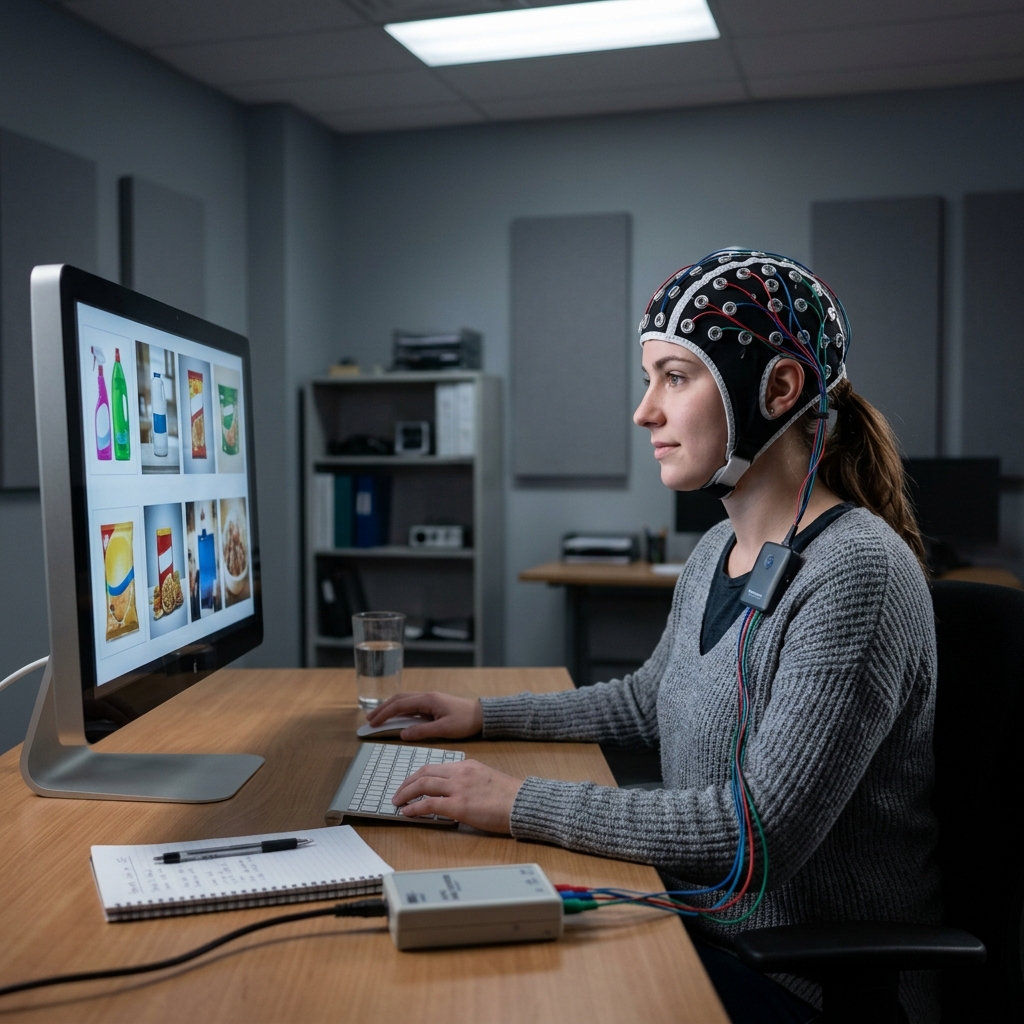
This study will employ a within-subjects experimental design, allowing for the control of individual differences in baseline neurophysiological activity. Participants will be exposed to a randomized sequence of visual advertising stimuli comprising two primary conditions: AI-generated images and human-created (traditional) images, matched for product category, color palette, and general semantic content. A statistically robust sample of participants (N = 60) will be recruited using purposive sampling. Selection criteria will require participants to be right-handed (to ensure standardized cortical mapping), possess normal or corrected-to-normal vision, and have no history of neurological or psychiatric disorders. The experimental setup will take place in a controlled, dimly lit, and sound-attenuated laboratory environment to minimize extraneous sensory artifacts. After providing informed consent, participants will be fitted with the necessary neurophysiological apparatus, undergo a brief baseline calibration period, and subsequently view the stimuli presented on a high-definition monitor while their data is continuously recorded (Kennedy & Northover, 2016).
Data Collection
Data collection will be executed utilizing a multimodal approach, synchronizing both central and peripheral physiological measurements. Cortical activity will be recorded using a high-density, 64-channel EEG system placed according to the international 10-20 system, sampled at a frequency of 500 Hz. Concurrently, visual attention will be captured using a screen-based, infrared eye-tracker operating at a sampling rate of 120 Hz to ensure precise recording of rapid saccadic movements and micro-fixations. The emotional and cognitive responses will be primarily measured through two derived indices: emotional valence, calculated by the difference in alpha-band power between the right and left frontal hemispheres (Frontal Alpha Asymmetry), and visual engagement, measured by total fixation duration and visit counts within predefined Areas of Interest (AOIs) on the advertising stimuli. Following the physiological data collection, participants will complete a brief post-task semantic differential questionnaire to gather explicit behavioral data regarding brand attitude and purchase intention, serving as a supplementary dataset for correlation analysis (Reinerman-Jones et al., 2011).
Data Analysis
The raw neurophysiological data will undergo rigorous pre-processing and artifact rejection prior to statistical analysis. EEG data will be filtered (e.g., 1-50 Hz bandpass filter), re-referenced, and subjected to Independent Component Analysis (ICA) to remove ocular and muscular artifacts. The cleaned data will then be transformed into the frequency domain via Fast Fourier Transform (FFT) to extract spectral power in the specified frequency bands (Alpha, Beta). Eye-tracking data will be analyzed to generate heat maps, gaze plots, and aggregate metrics for the predefined AOIs. Statistical analysis will primarily employ repeated-measures Analysis of Variance (ANOVA) to assess the main effects of the stimulus condition (AI vs. Human) on both the EEG valence indices and eye-tracking metrics. Furthermore, mixed-effects linear regression models and Pearson correlation coefficients will be employed to examine the predictive relationship between the implicit physiological responses and the explicitly stated behavioral intentions gathered from the post-task questionnaire. All findings will be interpreted within the theoretical frameworks of the Elaboration Likelihood Model and the Appraisal Theory of Emotion to address the core research objectives (Romero et al., 2004).
Expected Outcomes and Implications
Anticipated Findings
Based on the synthesis of current literature regarding algorithm aversion and visual processing, it is anticipated that the research will yield several distinct findings. First, we predict that AI-generated visuals will elicit a statistically significant higher cognitive load (evidenced by increased theta and beta band activity) compared to traditional visuals, reflecting the brain’s attempt to process novel or subtly incongruent synthetic features. Second, regarding emotional valence, we hypothesize a bifurcated response: highly polished AI visuals may generate positive frontal asymmetry akin to traditional ads, whereas AI visuals displaying “uncanny” traits will precipitate negative frontal asymmetry (withdrawal response). Third, eye-tracking data is expected to reveal longer fixation durations and more erratic saccadic pathways on AI-generated human faces or complex elements, indicating intensive visual search and plausibility evaluation by the consumer. Ultimately, these findings will contribute a vital empirical dataset to the field of neuromarketing, providing the first physiological baseline for consumer interaction with generative marketing content (Livingston, 2024).
Practical Implications
The findings from this study will provide profound, actionable insights for contemporary marketers, advertisers, and creative directors. By moving beyond subjective consumer feedback, advertisers will gain objective benchmarks to evaluate the efficacy of AI-generated content before launching extensive campaigns. If AI-generated visuals are shown to induce higher cognitive friction or negative emotional valence, marketers can strategically recalibrate their use of generative tools—perhaps limiting them to background elements or inanimate objects rather than human models. Conversely, if certain AI aesthetics prove to be highly engaging and emotionally resonant, it will validate the aggressive integration of AI in creative workflows to maximize return on ad spend. Broadly, this research will inform the ethical and strategic design of advertising visuals, ensuring that the pursuit of cost-effective, machine-generated content does not inadvertently compromise positive brand perception, consumer trust, and deeper psychological engagement (Lee et al., 2025).
Conclusion
Summary of Proposal
This research proposal outlines a rigorous, multidisciplinary investigation into the implicit emotional and cognitive impact of AI-generated advertising visuals on consumers. By leveraging the advanced methodologies of neuromarketing—specifically the synchronous deployment of EEG and eye-tracking technology—the study aims to transcend the limitations of traditional self-reported measures. The research will systematically compare neurological valance, cognitive load, and visual attention allocation between AI-generated and human-created advertising stimuli. In doing so, this study will critically advance the academic domain of neuromarketing by introducing empirical, physiological data to the discourse on generative AI, while simultaneously offering practical frameworks for advertisers navigating an increasingly synthetic media landscape.
Future Research Directions
While this study focuses on static visual advertising, its methodology establishes a foundational paradigm that necessitates further exploration. Future research should extend this neurophysiological approach to dynamic AI-generated content, such as synthetic video advertisements and AI-driven interactive avatars. Furthermore, longitudinal studies are required to determine whether consumer algorithm aversion and the associated negative emotional responses habituate over time as the public becomes increasingly exposed to synthetic media. Finally, as the resolution and capabilities of generative AI models continue to evolve at an exponential rate, continuous neuromarketing assessments will be imperative to understand the moving target of the “uncanny valley” and to fully delineate the long-term implications of machine-generated realities on human consumer psychology.
References
Akbari, M. (2014). An Overview to Neuromarketing and its application. The Neuroscience Journal of Shefaye Khatam, 2(1), 75–84. https://doi.org/10.18869/acadpub.shefa.2.1.75
Kennedy, R., & Northover, H. (2016). How to Use Neuromeasures To Make Better Advertising Decisions. Journal of Advertising Research, 56(2), 183–192. https://doi.org/10.2501/jar-2016-019
Lee, G., Park, J., & Kim, H.-Y. (2025, January 18). How AI’s Role Impacts Perceptions of AI Ad Image vs. Artwork. https://doi.org/10.31274/itaa.18835
Livingston, W. (2024). Americans’ views of artificial intelligence: identifying and measuring aversion. AI & SOCIETY, 40(5), 3531–3545. https://doi.org/10.1007/s00146-024-02075-y
Matukin, M., Ohme, R., & Boshoff, C. (2016). Toward a Better Understanding of Advertising Stimuli Processing. Journal of Advertising Research, 56(2), 205–216. https://doi.org/10.2501/jar-2016-017
Raut, S., Chandel, A., & Mittal, S. (2024). Enhancing Marketing and Brand Communication With AI-Driven Content Creation (pp. 139–172). Igi Global. https://doi.org/10.4018/979-8-3373-0219-5.ch008
Reinerman-Jones, L., Taylor, G., Cosenzo, K., & Lackey, S. (2011). Analysis of Multiple Physiological Sensor Data (pp. 112–119). Springer Berlin Heidelberg. https://doi.org/10.1007/978-3-642-21852-1_14
Romero, S., Mananas, M. A., Riba, J., Morte, A., Gimenez, S., Clos, S., & Barbanoj, M. J. (2004). Evaluation of an automatic ocular filtering method for awake spontaneous EEG signals based on independent component analysis. 2004, 925–928. https://doi.org/10.1109/iembs.2004.1403311
Saha, K. (2025). Synthesizing Desire: An Investigation into Consumer Trust and Purchase Intent Towards AI-Generated Product Imaginary and Ad Copy. European Economic Letters. https://doi.org/10.52783/eel.v15i4.4070
0 Komentar