
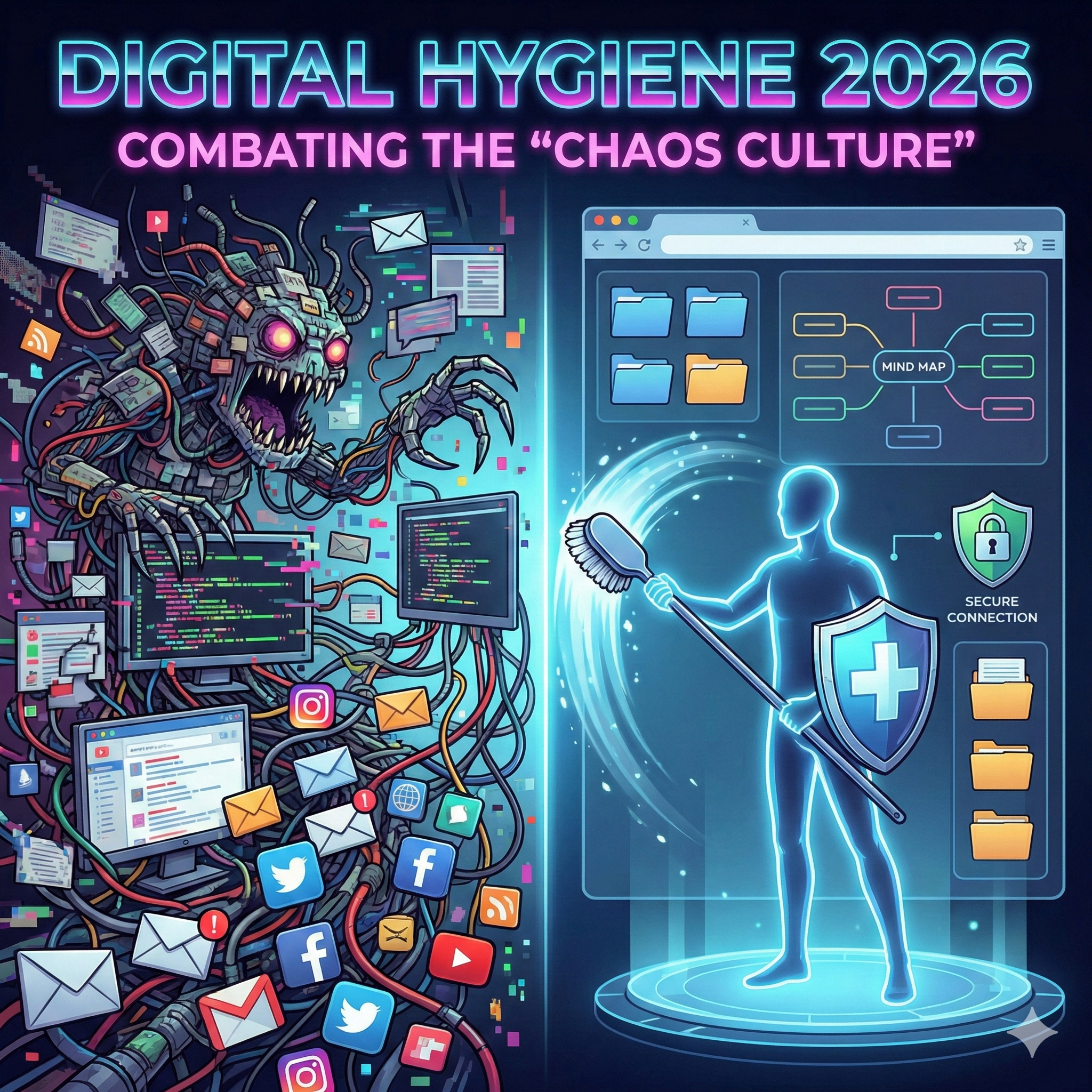
Digital Hygiene 2026: How to Survive Online ‘Chaos Culture’. Discover expert strategies to combat brainrot, secure your data against quantum threats, and reclaim your focus in an era of algorithmic overload.
Introduction: The Imperative of Digital Hygiene in the Era of Chaos
The year is 2026, and the digital landscape has shifted from a tool of convenience to an environment of relentless, chaotic pressure. We have transitioned past the Information Age into what sociologists and digital anthropologists now term the “Chaos Era.” In this new reality, Digital Hygiene is no longer merely about organizing your desktop folders or limiting screen time; it has evolved into a survival skill essential for preserving cognitive function, mental health, and personal sovereignty.1
The sheer velocity of information has reached a tipping point. Global data creation has surged to an estimated 175 zettabytes annually, creating a deluge that drowns the individual in a sea of noise.3 This is not passive noise; it is an aggressive, algorithmic assault designed to fracture attention and monetize distraction. The resulting cultural phenomenon, known as Chaos Culture, is characterized by nonsense humor, rapid-fire visual stimulation, and a fragmentation of narrative that mirrors the fractured attention spans of its consumers.4
For the modern individual, the cost of navigating this environment without a robust Digital Hygiene strategy is steep. We are witnessing a mental health crisis of unprecedented scale, with “Popcorn Brain”—a state of scattered attention and inability to focus—becoming the baseline cognitive state for millions.5 Burnout rates among digital natives have skyrocketed, with over 80% of Millennials and Gen Z reporting significant exhaustion due to the pressures of maintaining a curated digital existence amidst economic and social instability.4
Furthermore, the security landscape of 2026 presents existential threats that render traditional cybersecurity advice obsolete. The looming advent of quantum computing has birthed “harvest now, decrypt later” attacks, necessitating a shift toward quantum-resilient security habits.7 Artificial Intelligence, once a novelty, now powers sophisticated phishing campaigns and deepfake identity theft, requiring individuals to adopt “Digital Masking” techniques to protect their biological and digital identities.8
This report provides a comprehensive, expert-level analysis of the state of the digital union in 2026. It offers a rigorous, evidence-based framework for Digital Hygiene, moving beyond superficial “detox” advice to actionable protocols for neuro-protection, data sovereignty, and cognitive defense. It is a guide for the professional, the parent, and the privacy-conscious citizen seeking to navigate the Chaos Culture without losing their mind—or their data.
The Anatomy of Chaos Culture: Understanding the Enemy
To combat the chaos, one must first understand its architecture. Chaos Culture is not random; it is a systemic response to overstimulation and a reflection of the algorithmic incentives that govern our platforms.
Defining Chaos Culture in 2026
Chaos Culture represents a profound shift in content norms, primarily driven by the influence of Generation Alpha (those born 2010–2025) and the algorithmic preference for high-velocity engagement.4 Unlike the curated “Instagram aesthetic” of the 2010s, which prioritized perfection and coherence, Chaos Culture embraces absurdity, noise, and disorder.
The Visual Language of Brainrot
The aesthetic of Chaos Culture is often described colloquially as “Brainrot”—a term that has migrated from internet slang to psychological discourse.11 This content style is defined by:
- Sensory Overload: Videos feature distorted audio (bass-boosting, ear-rape), rapid editing cuts (sub-second duration), and split-screen gameplay (e.g., Subway Surfers) alongside unrelated storytelling to artificially retain attention.12
- Narrative Displacement: Traditional storytelling structures (beginning, middle, end) are abandoned in favor of non-sequiturs and randomness. The “punchline” is often the absence of logic, designed to short-circuit critical thinking and trigger a confused, reactive engagement.4
- Absurdist Humor: Trends like the “67” meme or the evolution of “skibidi” variants demonstrate a collective retreat into nonsense. This is a defense mechanism: for a generation raised during poly-crises (climate, pandemic, economic), absurdism offers a way to process a reality that feels equally chaotic but far less fun.4
The Algorithmic Feedback Loop
This culture is sustained by algorithms that have evolved to prioritize “Time on Device” (ToD) above all else. In 2026, algorithms no longer just measure clicks; they analyze micro-behaviors—hover time, scroll speed, and even biometric indicators of attention—to serve content that triggers immediate neurological arousal.10
- The Outrage Economy: Content that elicits high-arousal emotions (anger, fear, shock) travels faster than content that induces calm. Chaos Culture monetizes this biology, creating a feed that is a perpetual “breaking news” cycle of micro-dramas and existential threats.1
- Variable Reward Schedules: The feed operates like a slot machine. The unpredictability of the next swipe—will it be a dopamine hit, a rage-bait video, or a life update?—keeps the brain in a state of hyper-vigilance, known as a variable reward schedule. This is the most addictive pattern known to behavioral psychology.13
The Generational Impact of Chaos
While Chaos Culture permeates the entire internet, its impact varies significantly across generations, creating distinct challenges for Digital Hygiene strategies.
Table 1: Generational Responses to Chaos Culture (2026)
| Generation | Relationship to Digital Chaos | Primary Mental Health Challenge | Dominant Coping Mechanism |
| Gen Alpha (Ages 1-16) | Native Architects: They create and consume chaos natively. High tolerance for multi-modal stimulation. | Brainrot & Attention Deficits: Struggle with long-form literacy and sustained focus.14 | Gamification: Viewing life through the lens of game mechanics and “brainrot” humor. |
| Gen Z (Ages 17-29) | The Burnout Generation: Caught between analog roots and digital acceleration. Highly aware of the negative effects but socially bound to platforms. | Anxiety & Performance Pressure: 81% report burnout; high incidence of “Algorithmic Anxiety”.4 | Digital Fatalism: “Doomscrolling” combined with ironic detachment. |
| Millennials (Ages 30-45) | Digital Nostalgics: Experiencing “tech fatigue.” They remember the pre-algorithm internet and actively seek to return to it. | Comparison Fatigue: Exhaustion from the “curated self” vs. the chaotic reality of parenting/work. | Cozy Web: Retreating to private group chats, “slow living” aesthetics, and retro tech.4 |
| Gen X & Boomers | The Disoriented: Often struggle to filter misinformation and “rage bait” from genuine news. | Information Overload: Difficulty distinguishing AI fabrication from reality; high susceptibility to scams. | Avoidance or Obsession: Either total disconnection or falling down conspiracy rabbit holes. |
The Rise of Algorithmic Anxiety
A specific psychological condition identified in 2026 is Algorithmic Anxiety.15 This is a form of chronic stress stemming from the awareness that one is constantly being evaluated, ranked, and sorted by opaque AI systems.
- The Black Box Effect: Users know their visibility—whether on a dating app, LinkedIn, or a gig platform—depends on an algorithm they cannot see or understand. This creates a state of suspended uncertainty, where every action (or inaction) feels like a potential error.15
- Performance Pressure: The need to “feed the beast” to remain relevant leads to a commodification of the self. Personal moments are packaged as content, and silence is feared as professional death. This erodes the boundary between the private self and the public persona, a key focus of Digital Hygiene.16
The Neurobiology of the Digital Age: Your Brain on Chaos
To understand why Digital Hygiene is critical, we must look at the biological cost of the digital environment. The human brain, evolved for linear processing and tangible threats, is maladapted to the hyper-speed, abstract environment of 2026.
“Popcorn Brain”: The Fracture of Focus
One of the most pervasive cognitive conditions in 2026 is Popcorn Brain.5 Coined by researcher David Levy and expanded upon by clinical psychologists, this term describes a brain circuit that has adapted to the frantic pace of the digital world.
- Mechanism of Action: Deep neuro-pathways are formed through repetition. When a brain is conditioned to switch tasks every 47 seconds (the average attention span on a screen in 2026), it loses the synaptic strength required for sustained focus.18 Thoughts begin to “pop” around like kernels in a heated machine—jumping from a work email to a shopping notification, to a news alert, and back—without ever settling.
- The Cost of Context Switching: Research indicates it takes approximately 23 minutes to regain deep focus after an interruption. A brain in “Popcorn” mode never reaches this recovery point, operating in a permanent state of cognitive deficit and “continuous partial attention”.19
- Physical Changes: Early studies suggest that chronic multitaskers may have reduced density in the anterior cingulate cortex, the region responsible for empathy and cognitive control. This structural change explains the correlation between high screen time and emotional dysregulation.17
The Dopamine Dysregulation Loop
At the core of Digital Hygiene failure is the dysregulation of the dopamine system. Dopamine is often misunderstood as the “pleasure molecule,” but it is actually the molecule of seeking. It drives the anticipation of reward.13
- The Supernormal Stimulus: Digital platforms act as “supernormal stimuli,” flooding the brain with dopamine at levels far exceeding natural experiences. A viral video or a flood of likes triggers a spike that the brain interprets as a high-value survival event.
- The Dopamine Trough: To maintain homeostasis, the brain downregulates its dopamine receptors in response to this flood. When the screen is removed, dopamine levels drop below baseline, leading to a “dopamine trough.” This manifests as boredom, irritability, anxiety, and anhedonia (inability to feel pleasure).
- The Craving Cycle: The only way to relieve the discomfort of the trough is to seek another high—picking up the phone again. This creates a physiological dependency that makes “willpower” an ineffective tool for Digital Hygiene. We are not fighting a habit; we are fighting our own neurochemistry.20
The Insomnia-Depression Axis
The link between information overload and physical health has cemented in 2026. Data confirms a robust correlation between information overload, insomnia, and depressive symptoms.21
- Cortisol and “Breaking News”: It is not just the blue light that disrupts sleep; it is the cortisol. The “Outrage Economy” ensures that content delivered at night is often emotionally charging. This triggers the sympathetic nervous system (fight or flight), making sleep physically impossible even if the eyes are closed.1
- The Doom Loop: Poor sleep reduces executive function the next day, making the brain more susceptible to “Popcorn” behavior and “Brainrot,” which in turn leads to more scrolling and worse sleep. This cycle is the primary driver of the mental health crisis in 2026.21
The 2026 Digital Hygiene Framework: A Strategic Protocol
In response to these existential threats to cognition, the field of Digital Hygiene has matured. It is no longer a collection of “life hacks” but a rigorous discipline centered on Audit, Boundary, and Substitution.
Phase 1: The Notification Audit (Human vs. Algorithm)
The first step in reclaiming attention is the Notification Audit. The “Do Not Disturb” button is a blunt instrument; the audit is a scalpel designed to filter signal from noise.
- Categorization Protocol: Notifications must be ruthlessly sorted into two categories:
- Human-Centric: Communications from real people that require personal attention (SMS, direct calls, specific encrypted messaging apps). These are permitted to bypass filters.1
- Algorithm-Centric: Generated by systems to pull attention back to the platform (likes, “people you may know,” trending news, “flash sale” alerts). These are universally silenced.
- Batching Strategy: In 2026, advanced AI tools and OS features allow for “Contextual Notification Delivery.” Users are encouraged to set “batch delivery” for algorithm-centric apps, receiving a single summary digest at 12:00 PM and 5:00 PM, rather than a continuous drip-feed. This reduces the cognitive load of constant interruption.22
Phase 2: Spatial Hygiene and “Blackout Zones”
Physical environments act as potent cognitive cues. If a phone is on the dining table, the brain remains in a state of “continuous partial attention,” anticipating an interruption. Digital Hygiene requires the establishment of hard physical boundaries.
- The Dining Table Protocol: This is a sacred “Blackout Zone.” Research indicates that the mere presence of a phone reduces the quality of conversation and empathy levels between diners. In 2026, households are adopting “phone baskets” or Faraday cages at the entrance of dining areas to enforce this boundary.1
- The Bedroom Sanctuary: The most critical hygiene intervention is removing devices from the bedroom. Charging the phone in the kitchen is the single most effective intervention for sleep hygiene. It prevents the “last check” before sleep and the “first check” upon waking—two habits that define the brain’s cortisol baseline for the day.1
- The “Digital Sunset”: A ritual borrowed from circadian biology. Users initiate a “digital sunset” 60-90 minutes before sleep, switching to passive, analog activities (reading, journaling) to allow dopamine levels to stabilize and melatonin to rise.1
Phase 3: Digital Minimalism and the 30-Day Rule
Digital Hygiene requires regular purging of “Digital Junk” to reduce the attack surface for distraction and anxiety.
- The 30-Day Unfollow Rule: If an account has not provided education, inspiration, or genuine joy in the last 30 days, it is unfollowed. This curation shifts the feed from a source of envy/outrage to a utilitarian tool.1
- Active vs. Passive Use: Psychology dictates that active use (posting, commenting, creating) is less harmful than passive use (lurking, scrolling). The goal is to transform the device from a slot machine (passive) into a toolbox (active).
- Data Deletion: “Digital Junk”—old accounts, unused apps, and archived emails—is a massive security liability. In 2026, Digital Minimalism includes the use of automated services (e.g., McAfee+, Cloaked) to scan for and delete old accounts that could serve as “backdoors” for hackers.9
Hardware and Software Interventions: Tools of the Trade
Beyond behavioral changes, the Digital Hygiene of 2026 relies on specific hardware and software choices that prioritize user sovereignty over algorithmic engagement.
The “Dumbphone” Renaissance
A significant trend in 2026 is the Dumbphone (or feature phone) revival. This is not Luddism; it is a strategic choice for high-functioning individuals seeking to reclaim their time.24
- The Device Ecosystem: Modern dumbphones (e.g., Light Phone III, Punkt MP02, Nokia revivals) have evolved. They offer essential utilities like 4G/5G hotspots, high-quality maps, and encrypted voice calls, but intentionally lack browsers, social media, and infinite scroll interfaces.25
- The “Companion” Model: Many users do not abandon smartphones entirely but use a “SIM-swapping” or “Multi-SIM” approach. The smartphone lives in a drawer or at the office for “heavy lifting” (banking, tickets), while the dumbphone is the daily carry device for evenings and weekends.
- Status Symbol: Paradoxically, the dumbphone has become a status symbol in 2026. It signals, “My time is too valuable to be stolen by an algorithm.” It implies the user has the professional autonomy to be offline, flipping the script on the “always-on” hustle culture.27
- Market Growth: Sales of feature phones in Western Europe and North America have seen double-digit growth, driven by Gen Z’s desire for “Digital Detox” and privacy advocates.28
Security Sovereignty: Quantum Resilience
The “Y2Q” (Year to Quantum) threat—where quantum computers break current encryption standards—is driving a massive shift in personal security protocols.7 Digital Hygiene now includes future-proofing one’s data.
- The Threat: “Harvest Now, Decrypt Later.” Hackers are stealing encrypted data today, waiting for quantum computers (expected mid-2030s) to unlock it. This means your current private data could be exposed in the future.30
- Post-Quantum Cryptography (PQC): In 2026, users must prioritize apps and services that have implemented PQC.
- Secure Messaging: Signal and Apple’s iMessage (PQ3 protocol) have already integrated PQC. Users should verify they are on the latest protocols.
- VPNs: Services like Surfshark and NordVPN have rolled out post-quantum protection on WireGuard protocols. Using a VPN is no longer just about location masking; it is about cryptographic hardening.2
- Passkeys over Passwords: By 2026, the password is dying. Biometric Passkeys (FIDO standards) are the default. They are un-phishable and cryptographically stronger than any user-generated password.32
Digital Masking and Privacy
Privacy in 2026 is not about hiding; it’s about masking. The “Digital Masking” trend involves using intermediate services to protect true identity data.8
- The “Digital Secretary”: Services like Cloaked or MySudo allow users to generate unique email addresses, phone numbers, and even credit card numbers for every single account they sign up for.
- Benefit: If one service is breached (e.g., a shopping site), the hacker gets a “masked” email and a “dead” credit card number. The user’s real identity (Social Security Number, primary email, bank account) remains untouched.
- Facial Masking: With the rise of facial recognition and deepfakes, researchers are developing “digital masks”—imperceptible overlays on photos that confuse AI recognition systems while leaving the image looking normal to humans. This is a crucial tool for maintaining privacy in an AI-surveilled world.8
Cognitive Defense Strategies: Reclaiming Your Mind
Digital Hygiene is ultimately about cognitive defense. It provides the psychological tools to resist the pull of Chaos Culture.
The Dopamine Menu: Engineering Satisfaction
To combat the “Dopamine Trough” that leads to relapse (picking up the phone out of boredom), experts recommend constructing a Dopamine Menu (or Dopamenu).20 This is a pre-written list of stimulating activities categorized by the time and energy they require. It removes the decision fatigue of “what should I do now?” which usually defaults to scrolling.
Table 2: The Dopamine Menu Framework
| Category | Description | Examples | Time Cost |
| Appetizers | Quick, instant hits of dopamine to shift state. | Petting the dog, drinking a glass of cold water, doing 5 jumping jacks, eating a sour candy. | < 5 mins |
| Entrées | Deeply engaging activities that induce “flow.” | Coding, painting, gardening, cooking a complex meal, playing an instrument. | 45+ mins |
| Sides | Activities that can be added to mundane tasks to make them engaging. | Listening to a podcast while folding laundry, audiobooks during commute, upbeat music while cleaning. | Variable |
| Desserts | High-pleasure, low-effort indulgences (use sparingly). | Social media scrolling, reality TV, video games. (Best consumed after an Entrée). | Variable |
| Specials | Occasional, high-novelty events. | Concerts, weekend trips, trying a new restaurant. | Rare |
Strategy: The menu should be physical (printed on the fridge) or the lock screen of the phone. When the urge to scroll hits, the user must “order” from the menu first.35
Monk Mode 2.0 and Deep Work
Monk Mode has evolved from an internet niche to a productivity standard for knowledge workers. It is a period of dedicated isolation for high-value work.36
- The Protocol:
- Solitude: No meetings, no casual chats.
- Digital Severance: Phone is off or in another room. Internet is often blocked on the work device (using tools like Freedom or Cold Turkey).
- Duration: Typically 2-4 hours. This aligns with the ultradian rhythms of the human brain.
- Biological Basis: It takes the brain roughly 15-20 minutes to reach “Flow State.” A single notification resets this clock. Monk Mode protects the “incubation” phase of creativity, allowing for the deep thought that Chaos Culture tries to extinguish.37
Cognitive Offloading
Cognitive Offloading is the practice of externalizing mental processes to reduce the load on working memory.38 In an age of information overload, trying to “remember” things is a waste of precious neural resources.
- Externalization: Everything actionable must be captured in a trusted external system (Notion, Obsidian, physical Bullet Journal). The mantra is “Your brain is for having ideas, not holding them” (David Allen).
- Chunking: Breaking complex projects into micro-tasks reduces the “friction” of starting. This combats procrastination, which is often just an emotional reaction to feeling overwhelmed.38
- The Paradox of AI Tools: While AI can help offload (summarizing emails, scheduling), over-reliance can lead to “Cognitive Atrophy.” The 2026 guideline is to use AI for execution but not for synthesis. You should write the outline; AI can format the table. If AI does the thinking, your critical faculties degrade.40
Societal Shifts and The Future: Towards 2030
As Chaos Culture accelerates, a Newtonian equal and opposite reaction is occurring: the “Slow Living” and “Analog” movements.
The Slow Living Counter-Movement
The visual trend of “cozy”—soft lighting, books, nature, slow food—is a direct balm to digital overstimulation. Linked to Frugal Optimism, this movement rejects hyper-consumerism (often driven by “Haul” videos) in favor of “making do,” repairing items, and finding joy in non-commercial experiences.4 This Tactile Renaissance sees a surge in analog hobbies—film photography, vinyl records, paper journals—that offer tactile feedback that glass screens lack, grounding the user in physical reality.41
Redefining “Work-Life Balance”
The 2026 workforce, dominated by Millennials and Gen Z, has redefined professional norms.4 Mental health is no longer a perk; it is a KPI. Companies are using “wellness dashboards” to ensure employees aren’t overheating. Legislation in various regions (Europe, Australia) now protects the Right to Disconnect, making after-hours emails legally risky for employers. This enforces the Digital Sunset at a structural level.
The 2030 Outlook: AI Guardians and the Bifurcation
As we look beyond 2026, Digital Hygiene will likely involve “AI Guardians”—personal agents that pre-screen communications and negotiate with marketing algorithms to protect user privacy.9 However, we risk a societal bifurcation:
- The Analog Elite: Those who can afford privacy, disconnection, and human interaction. They use “dumbphones,” attend screen-free schools, and pay for ad-free experiences.
- The Algorithmic Masses: Those whose lives are subsidized by data extraction. They are perpetually connected, paying for services with their attention and neurochemistry.
Conclusion: Becoming a Digital Stoic
Combating the Chaos Culture of 2026 is not about rejecting technology; it is about disciplining it. It is about recognizing that the human brain is an ancient biological machine trying to interface with a hyper-speed digital reality. The friction between these two creates the sparks of burnout, anxiety, and brainrot.
To survive, we must become Digital Stoics—cultivating an inner citadel of focus and calm that cannot be breached by the algorithmic siege. We must adopt the tools of the trade: the notification audit, the dumbphone, the dopamine menu, and quantum-grade encryption.
The goal of Digital Hygiene is ultimately agency. It is the ability to choose what we pay attention to, when we engage, and how we share our lives. In an age of infinite noise, the ability to command one’s own attention is the ultimate superpower.
Recommendations for Immediate Action:
- Tonight: Implement a “Digital Sunset.” No screens 60 minutes before bed. Charge the phone in the kitchen.
- Tomorrow: Perform a “Notification Audit.” Silence everything that is not a human being.
- This Weekend: Draft a “Dopamine Menu.” Post it on your fridge.
- Next Month: Investigate your security stack. Upgrade to a password manager with Passkey support and check if your VPN/Messaging apps are Quantum-Resilient.
The chaos is optional. The focus is yours to reclaim.
Works cited
- The 2026 Digital Hygiene Plan – Social Media Explorer, diakses Januari 28, 2026, https://socialmediaexplorer.com/social-media-marketing/the-2026-digital-hygiene-plan/
- From misinformation to AI-powered cyberattacks – the top cybersecurity risks for 2026, diakses Januari 28, 2026, https://www.tomsguide.com/computing/online-security/from-misinformation-to-ai-powered-cyberattacks-the-top-cybersecurity-risks-for-2026
- Data Anxiety: The Impact of Information Overload – EHL Insights, diakses Januari 28, 2026, https://hospitalityinsights.ehl.edu/data-anxiety
- The 18 social media trends to shape your 2026 strategy, diakses Januari 28, 2026, https://blog.hootsuite.com/social-media-trends/
- What is ‘popcorn brain’? Inside the alarming mental shift fueled by reels, shorts and infinite scroll – The Economic Times, diakses Januari 28, 2026, https://m.economictimes.com/magazines/panache/what-is-popcorn-brain-inside-the-alarming-mental-shift-fueled-by-reels-shorts-and-infinite-scroll/articleshow/125674761.cms
- 5 things to know about “popcorn brain” – Mayo Clinic Press, diakses Januari 28, 2026, https://mcpress.mayoclinic.org/mental-health/5-things-to-know-about-popcorn-brain/
- Six Trends To Watch Out for in 2026 from HP Wolf Security, diakses Januari 28, 2026, https://www.hp.com/us-en/newsroom/blogs/2025/six-trends-for-2026-hp-wolf-security.html
- Digital mask to safeguard sensitive info in patient facial images – Healthcare Asia, diakses Januari 28, 2026, https://www.healthcareasia.org/2022/digital-mask-to-safeguard-sensitive-info-in-patient-facial-images/
- New Year’s Data Privacy Checklist for 2026 – Cloaked, diakses Januari 28, 2026, https://www.cloaked.com/post/new-years-data-privacy-checklist-for-2026
- Social Media Trends 2026 – Hootsuite, diakses Januari 28, 2026, https://www.hootsuite.com/research/social-trends
- Brain Rot: The Impact on Young Adult Mental Health – Newport Institute, diakses Januari 28, 2026, https://www.newportinstitute.com/resources/co-occurring-disorders/brain-rot/
- Part 1 of a 3 part series – Gapingvoid, diakses Januari 28, 2026, https://www.gapingvoid.com/content/uploads/2020/03/leadership-in-the-time-of-coronavirus.pdf
- Digital hygiene: how to protect your child’s mental health? – Trinity Private School, diakses Januari 28, 2026, https://trinity.cy/digital-hygiene-how-to-protect-your-childs-mental-health/
- A chain mediation model of physical exercise and BrainRot behavior among adolescents – PMC – PubMed Central, diakses Januari 28, 2026, https://pmc.ncbi.nlm.nih.gov/articles/PMC12098985/
- Algorithmic Anxiety at the ICC: How AI Causes Power Imbalances in the Functioning of the Office of the Prosecutor – International Law Blog, diakses Januari 28, 2026, https://internationallaw.blog/2024/12/16/algorithmic-anxiety-at-the-icc-how-ai-causes-power-imbalances-in-the-functioning-of-the-office-of-the-prosecutor/
- Retail Therapy: The Looming Mental Health Risk Fueled by Social Media Algorithms – IRM India, diakses Januari 28, 2026, https://www.theirmindia.org/blog/retail-therapy-the-looming-mental-health-risk-fueled-by-social-media-algorithms/
- In the Era of Information Overload: An in-Depth Analysis and Coping Strategies for the ‘Popcorn Brain’ Phenomenon – Oreate AI Blog, diakses Januari 28, 2026, https://www.oreateai.com/blog/in-the-era-of-information-overload-an-indepth-analysis-and-coping-strategies-for-the-popcorn-brain-phenomenon/58d7337a21f38fb0d638bec72c712ff3
- 2 Ways to Avoid the Development of “Popcorn Brain” | Psychology Today, diakses Januari 28, 2026, https://www.psychologytoday.com/us/blog/social-instincts/202404/2-ways-to-avoid-the-development-of-popcorn-brain
- Five principles to reduce cognitive load (and how to apply them) | by David R Oliver, diakses Januari 28, 2026, https://medium.com/@davidroliver/five-principles-to-reduce-cognitive-load-and-how-to-apply-them-60f78276169d
- As a Therapist With ADHD, Here’s What’s On My Dopamine Menu – Verywell Mind, diakses Januari 28, 2026, https://www.verywellmind.com/as-a-therapist-with-adhd-here-s-what-s-on-my-dopamine-menu-8610279
- Too much social media to sleep: the chained mediation effect of information strain and depressive symptoms on the relationship between social media overload and insomnia – PMC – NIH, diakses Januari 28, 2026, https://pmc.ncbi.nlm.nih.gov/articles/PMC11998352/
- Unplug to Recharge: Why a Digital Detox Is the Real Power Move for 2026 – Vail Health, diakses Januari 28, 2026, https://www.vailhealth.org/news/unplug-to-recharge-why-a-digital-detox-is-the-real-power-move-for-2026
- New Year Reset: A Quick Guide to Improving Your Digital Hygiene in 2026 | McAfee Blog, diakses Januari 28, 2026, https://www.mcafee.com/blogs/tips-tricks/new-year-reset-a-quick-guide-to-improving-your-digital-hygiene-in-2026/
- Dumbphones Surge in 2026: Boosting Focus Amid Digital Overload – WebProNews, diakses Januari 28, 2026, https://www.webpronews.com/dumbphones-surge-in-2026-boosting-focus-amid-digital-overload/
- Digital Media’s ‘Off Era’ Is So On – Muse by Clio, diakses Januari 28, 2026, https://musebyclios.com/musings/digital-medias-off-era-is-so-on/
- Smartphone vs. Dumb Phone: Why People Are Going Basic – CNET, diakses Januari 28, 2026, https://www.cnet.com/tech/mobile/best-dumb-phones-guide/
- Why Dumb Phones Are Becoming a Status Symbol in 2026 — Gen Z, Analog Life & Digital Burnout – YouTube, diakses Januari 28, 2026, https://www.youtube.com/watch?v=E_dKgr54lL4
- ‘Dumb phone’ why are we seeing a rise in popularity? Part 1 – Punkt., diakses Januari 28, 2026, https://www.punkt.ch/blogs/editorials/dumb-phone-popularity
- Preparing for the Quantum Era – Digital Economy Trends 2026, diakses Januari 28, 2026, https://det.dco.org/35-preparing-quantum-era
- G7’s Post‑Quantum Roadmap: Preparing the Financial Sector for a Quantum-Resilient Future, diakses Januari 28, 2026, https://postquantum.com/security-pqc/g7-postquantum-roadmap-pqc/
- Surfshark Protects Against Future Quantum Threats As App Resilience Remains Low At 8%, diakses Januari 28, 2026, https://quantumzeitgeist.com/surfshark-quantum-computing-quantum-threats/
- Cyber Hygiene Checklist for 2025 – SecPod Blog, diakses Januari 28, 2026, https://www.secpod.com/blog/cyber-hygiene-checklist-for-2025/
- What the Fawkes: Facial Recognition, Digital Masking, and AI – Information Week, diakses Januari 28, 2026, https://www.informationweek.com/machine-learning-ai/what-the-fawkes-facial-recognition-digital-masking-and-ai-
- 6 Practical Steps To Build A Dopamine Menu For ADHD (With Templates), diakses Januari 28, 2026, https://lifeskillsadvocate.com/blog/dopamine-menu-for-adhd/
- Using a Dopamine Menu to Stimulate Your ADHD Brain – ADDitude, diakses Januari 28, 2026, https://www.additudemag.com/dopamenu-dopamine-menu-adhd-brain/
- Disappear for 6 Months: Build Habits, Health, and Wealth in Less Than a Year – Headway, diakses Januari 28, 2026, https://makeheadway.com/blog/disappear-for-6-months-rules/
- Productivity Hacks For Professionals: The 2026 Future Of Work Guide | LeanWisdom, diakses Januari 28, 2026, https://www.leanwisdom.com/blog/productivity-hacks-for-professionals/
- 10 Powerful Working Memory Improvement Strategies for 2026 | Fluidwave, diakses Januari 28, 2026, https://fluidwave.com/blog/working-memory-improvement-strategies
- Unlock Your Brain’s Potential with the Cognitive Unloading Method – Studying Machine, diakses Januari 28, 2026, https://studyingmachine.com/unlock-your-brains-potential-with-the-cognitive-unloading-method/
- AI Tools in Society: Impacts on Cognitive Offloading and the Future of Critical Thinking, diakses Januari 28, 2026, https://www.mdpi.com/2075-4698/15/1/6
- The $2 trillion global wellness market gets a millennial and Gen Z glow-up – McKinsey, diakses Januari 28, 2026, https://www.mckinsey.com/industries/consumer-packaged-goods/our-insights/future-of-wellness-trends
- How Dashboards and Slack Unwittingly Turn Accountability Into Invisible Micromanagement, diakses Januari 28, 2026, https://newsroom.bamboohr.com/invisible-micromanagement-jonathan-westover-wgu/
0 Komentar